
You Googled “ai mvp cost breakdown” because someone gave you a range so wide it was useless. “$10,000 to $500,000.” Thanks. That is like asking what a car costs and hearing “somewhere between a used Honda and a Ferrari.”
Here is something more useful: the actual cost ranges from real AI MVP engagements, broken down by component, complexity tier, and engagement model. We work with AI founders at Downshift, sometimes building alongside them, sometimes handling the hard infrastructure and architecture pieces they cannot tackle with AI coding tools alone. We know what things cost because we scope them every week. This is the breakdown we wish existed when we started.
AI MVP Cost at a Glance
Before we get into the details, here is the summary table. Bookmark this.
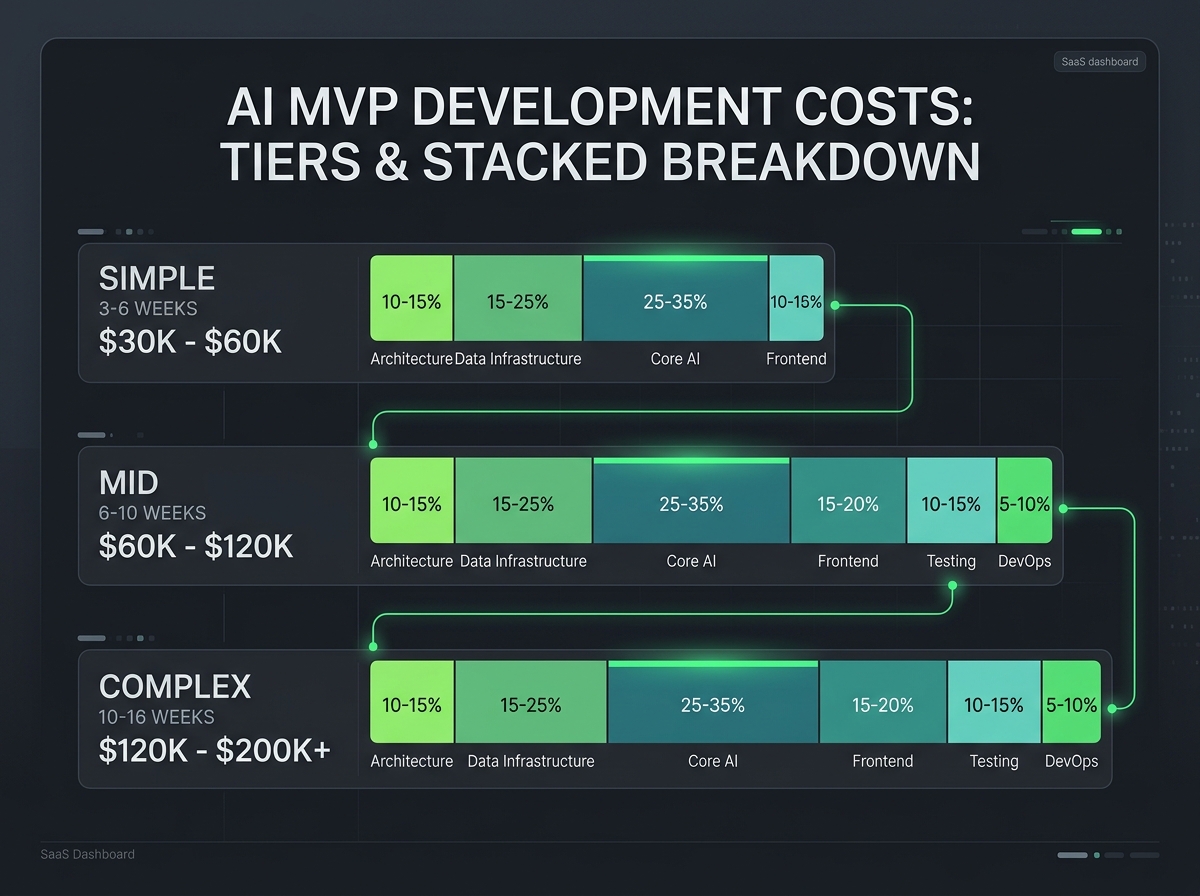
| Complexity Tier | Total Cost Range | Timeline | Example |
|---|---|---|---|
| Simple AI MVP | $30,000 - $60,000 | 3-6 weeks | LLM chatbot, AI content tool, single-model app |
| Mid-Complexity AI MVP | $60,000 - $120,000 | 6-10 weeks | RAG pipeline + dashboard, multi-model workflow, AI SaaS |
| Complex AI MVP | $120,000 - $200,000+ | 10-16 weeks | Custom ML + LLM hybrid, real-time AI system, multi-tenant AI platform |
These numbers reflect 2026 market rates for US-based senior teams. Offshore teams run 40-60% lower. Solo freelancers run 50-70% lower. You get what you pay for. We cover the tradeoffs in the engagement model section.
Want a number specific to your project? Book a free strategy call. 30 minutes, no pitch. We will help you figure out what you can build yourself with modern AI tools and where you might need expert support.
Why AI MVPs Cost More Than Traditional MVPs
A traditional SaaS MVP (user auth, CRUD operations, a dashboard, Stripe billing) runs $15,000-$40,000 with a competent team. An AI MVP of comparable scope starts at $30,000 and goes up from there. The difference is not developer ego. It is real technical complexity that does not exist in traditional software.
AI-Specific Cost Factors
Three things make AI MVPs more expensive than traditional MVPs.
Probabilistic outputs require guardrails. Traditional software is deterministic. If a user clicks “Save,” the record saves. AI software is probabilistic. If a user asks your chatbot a question, the answer might be correct, partially correct, or a confident-sounding hallucination. Building the guardrails (input validation, output verification, confidence scoring, fallback logic, human-in-the-loop escalation) adds 15-25% to development costs.
Evaluation frameworks are mandatory. You cannot ship AI without measuring whether it works. That means building evaluation pipelines: test datasets, accuracy metrics, regression tests for model behavior, A/B testing infrastructure. Traditional MVPs need unit tests. AI MVPs need unit tests plus model evaluation. Budget 10-15% of development cost for this.
Iteration cycles are different. When traditional software has a bug, you find the line of code and fix it. When an AI model produces bad outputs, you might need to adjust prompts, retune retrieval parameters, add training examples, restructure your data pipeline, or switch models entirely. Debugging AI is closer to experimental science than software engineering. Budget time and money for at least 2-3 iteration cycles on the AI layer.
Infrastructure Costs (Cloud, GPU, APIs)
AI infrastructure costs money that traditional apps do not spend. Here are the real numbers.
LLM API costs run $500-$3,000/month for a typical MVP in testing and early usage. GPT-4o costs roughly $2.50 per million input tokens and $10 per million output tokens. Claude 3.5 Sonnet is comparable. A document analysis tool processing 100 documents per day generates roughly $800-$1,500/month in API costs. A chatbot handling 1,000 conversations per day runs $1,500-$3,000/month.
Vector database hosting for RAG applications adds $50-$500/month. Pinecone starts at $70/month for production workloads. Self-hosted pgvector on a managed PostgreSQL instance runs $30-$100/month.
GPU compute applies only if you are training or fine-tuning models. Most MVPs should not be doing this. If you are, expect $500-$5,000/month for cloud GPU instances (AWS p4d, GCP A100).
Data Pipeline Development
Every AI MVP needs a data pipeline. The complexity of that pipeline is one of the biggest cost variables.
A simple pipeline (user submits text, text goes to LLM API, response comes back) adds minimal cost. A RAG pipeline (documents ingested, chunked, embedded, stored in a vector database, retrieved at query time, fed to an LLM with context) adds $5,000-$15,000 to the build. A complex pipeline with multiple data sources, real-time ingestion, transformation logic, and quality monitoring adds $15,000-$30,000.
Model Training and Fine-Tuning
Most AI MVPs in 2026 should not fine-tune models. Use pre-trained models via API calls. Prompt engineering and RAG cover 90% of MVP use cases.
If you genuinely need fine-tuning (domain-specific terminology, specialized output formats, performance optimization), budget $5,000-$20,000 for the fine-tuning work itself, plus ongoing compute costs for hosting the fine-tuned model. This is a post-validation optimization for most startups, not an MVP requirement.
Cost Breakdown by Component
Here is where the money goes in a typical AI MVP engagement, expressed as a percentage of total cost.
Architecture and Planning (10-15%)
System design, AI architecture selection, tech stack decisions, data model design, API design, and technical specification. This phase prevents expensive mistakes. Skipping it to save 10% costs you 40% in rework later. For a $50,000 project, this is $5,000-$7,500.
Data Infrastructure (15-25%)
Database setup, vector database configuration, data ingestion pipeline, embedding generation, data preprocessing, and storage. RAG-heavy projects land at the high end. Simple LLM API wrappers land at the low end. For a $50,000 project: $7,500-$12,500.
Core AI/ML Development (25-35%)
The AI layer itself: LLM integration, prompt engineering, retrieval pipeline, model evaluation, guardrails, output formatting, error handling, and iteration. This is the most variable component. A single-model chatbot with good prompts costs far less than a multi-model pipeline with custom retrieval and structured output parsing. For a $50,000 project: $12,500-$17,500.
Frontend and UX (15-20%)
User interface design and development, onboarding flow, core interaction screens, results display, loading states, error states. AI products need more UX work than most founders expect. Presenting probabilistic outputs in a way that builds user trust is a design problem, not just a technical one. For a $50,000 project: $7,500-$10,000.
Testing and QA (10-15%)
Unit tests, integration tests, AI output evaluation, edge case testing, load testing, and user acceptance testing. AI MVPs require more testing than traditional MVPs because you are testing both deterministic software behavior and probabilistic model behavior. For a $50,000 project: $5,000-$7,500.
DevOps and Deployment (5-10%)
CI/CD pipeline, production deployment, environment management, monitoring setup, logging, and alerting. Standard infrastructure work, but AI products add LLM observability tools (LangSmith, Helicone) for tracking model performance in production. For a $50,000 project: $2,500-$5,000.
Ongoing Costs After Launch
The build cost is the upfront investment. Ongoing costs are your monthly burn. Budget for these from day one.
Cloud and API Costs
Plan for $1,000-$5,000/month in the first six months. This covers LLM API usage, cloud hosting, database hosting, vector database, CDN, and monitoring tools. The number scales with usage. 100 daily active users costs less than 10,000. Build usage-based pricing into your business model so revenue scales with your AI costs.
Model Monitoring and Retraining
AI model performance degrades over time. User needs change. New edge cases emerge. The underlying LLM providers update their models (sometimes breaking your prompts in the process). Budget $2,000-$5,000/month for ongoing model monitoring, prompt optimization, and periodic retuning of your retrieval pipeline. Some months you spend nothing. Some months a model update breaks your core flow and you spend a week fixing it.
Maintenance and Updates
Standard software maintenance: bug fixes, security patches, dependency updates, feature requests. Budget 15-20% of the original build cost annually. For a $50,000 MVP, that is $7,500-$10,000/year, or roughly $600-$850/month.
How to Reduce AI MVP Costs
You cannot build a good AI MVP for free. But you can avoid spending money in the wrong places.
Start with Pre-Trained Models
Do not train a custom model for your MVP. OpenAI, Anthropic, Google, and open-source models (Llama, Mistral) cover the vast majority of use cases. A well-crafted prompt with GPT-4o or Claude outperforms a poorly trained custom model every time. Save custom model work for after you have validated demand.
Use Managed AI Services
Every hour your team spends configuring GPU instances, managing model deployments, or building evaluation infrastructure from scratch is an hour not spent on your product. Use managed services: LangChain/LlamaIndex for orchestration, Pinecone for vector search, Vercel/Railway for deployment, Sentry for monitoring. The monthly fees are cheaper than the engineering time to build equivalents.
Limit Initial Feature Scope
The most expensive AI MVP mistake is building three AI features instead of one. Each additional AI capability adds its own data pipeline, evaluation framework, guardrails, and iteration cycles. Ship one AI feature that works well. Add the second after users prove the first one matters.
Validate Before Building
Spend $2,000-$5,000 on validation before spending $30,000-$50,000 on building. Build a prototype (a Jupyter notebook, a Streamlit app, a prompt playground) that proves the AI can produce outputs good enough to test with users. Show it to 15-20 potential customers. If the AI output does not impress them, no amount of frontend polish will change that.
What This Looks Like in Practice
A healthcare founder came to us after spending $85,000 on a custom RAG pipeline with three specialized models, a fine-tuned classifier, and a dedicated GPU instance. Monthly infrastructure cost: $3,200. The system worked, but it was overbuilt for what users actually needed.
We rebuilt the core functionality in three weeks using a single LLM API call with a well-structured prompt and managed vector search. Same output quality for the use cases that mattered. Infrastructure cost dropped to $340/month. Total rebuild cost: under $15,000. The founder reinvested the savings into user acquisition and hit 200 paying users within two months.
The lesson is not “spend less.” It is “spend on the right layer.” The AI was never the bottleneck. Distribution was.
Building on a budget? Book a free strategy call. We will help you figure out what to build yourself with AI tools and where expert support actually moves the needle.
AI MVP Cost by Engagement Model
The same MVP built by different teams costs different amounts. Here is an honest comparison.
| Model | Cost Range | Timeline | What You Get | Risk |
|---|---|---|---|---|
| Dev Agency | $50K - $150K | 3-6 months | Full team, project management, defined deliverables | Slow, expensive, often no AI-specific expertise |
| Freelancers | $10K - $40K | 2-4 months | Flexible, cheaper, direct communication | Coordination overhead, inconsistent quality, no strategic guidance |
| In-House Team | $80K - $200K+ | 3-6 months | Full control, long-term alignment, IP ownership clear | Hiring takes 3-6 months, salaries start immediately, managing AI talent is hard |
| Co-Founder as a Service | $30K - $50K | 3-6 weeks | Technical leadership + execution, fixed price, founder-level judgment | Engagement ends (transition support included) |
The agency model works when you have a clear spec and enough budget for a 3-6 month timeline. Freelancers work when you have technical judgment yourself and can manage multiple contractors. In-house works when you are post-Series A with runway to hire and wait.
The collaborative model, what we do at Downshift, works when you are building with AI coding tools and need a senior technical partner for the pieces those tools cannot handle: AI infrastructure, architecture decisions, production hardening, scaling, and security. You get the strategic thinking (which model to use, which features to cut, which architecture survives scale) plus hands-on help where it matters most. We build with you, not for you. No equity.
FAQ
How much does it cost to build an AI MVP?
A simple AI MVP (single LLM integration, basic UI) costs $30,000-$60,000. Mid-complexity builds (RAG pipeline, multiple AI features, custom dashboard) run $60,000-$120,000. Complex AI MVPs with custom models, real-time processing, or multi-tenant architecture cost $120,000-$200,000+. These ranges reflect US-based senior teams. Add 15-30% for ongoing monthly costs (API usage, hosting, monitoring) in the first year.
What is the cheapest way to build an AI MVP?
Start with pre-trained model APIs (OpenAI, Anthropic), use managed infrastructure (Vercel, Supabase, Pinecone), limit scope to one core AI feature, and validate with a prototype before committing to a full build. In 2026, AI coding tools like Lovable, Bolt, Cursor, and v0.dev make it realistic for founders to build a surprising amount themselves, especially the frontend, basic workflows, and integrations. The cheapest responsible path is building what you can with those tools and bringing in expert help for the genuinely hard parts: AI infrastructure, production hardening, architecture, and security. A focused engagement for just those pieces can run $10,000-$30,000. Going fully DIY works for some founders, but budget extra time for the infrastructure and scaling challenges that AI coding tools do not solve.
How much do AI API costs add to an MVP budget?
LLM API costs typically add $500-$3,000/month during MVP testing and early usage. GPT-4o runs roughly $2.50/$10 per million input/output tokens. Claude is comparable. A document processing tool handling 100 docs/day costs $800-$1,500/month in API fees. A high-volume chatbot costs $1,500-$3,000/month. These costs scale with usage. Build usage-based pricing into your business model.
Are there hidden costs in AI MVP development?
Yes. The four most common hidden costs: (1) AI evaluation and testing adds 10-15% to development cost, and most quotes exclude it. (2) Data preparation for RAG applications adds $5,000-$15,000 that is easy to underestimate. (3) Post-launch model monitoring and prompt maintenance runs $2,000-$5,000/month. (4) LLM provider price changes or model deprecations can force unplanned migration work. Ask any vendor what is excluded from their quote, not just what is included.
How does AI MVP cost compare to traditional MVP cost?
AI MVPs cost 1.5-3x more than comparable traditional MVPs. A traditional SaaS MVP runs $15,000-$40,000. The same product with AI at the core runs $30,000-$120,000. The premium comes from three sources: AI-specific infrastructure (vector databases, GPU compute, API costs), guardrail development (handling probabilistic outputs), and evaluation frameworks (measuring AI accuracy). Ongoing costs are also higher. AI API usage adds $500-$5,000/month that traditional SaaS does not have.
You have the numbers. The next step is matching them to your specific product. Book a free strategy call. In 30 minutes, we will map your features to a complexity tier, identify what you can build yourself with AI coding tools, and scope the pieces that need senior engineering. No pitch deck required. Bring your idea and we will give you a realistic budget and timeline.