
AI MVP Development for Startups
90% of AI startups fail. The most common reason is not bad technology. It is building the wrong thing, too slowly, without the right technical guidance. In 2026, founders can build more than ever with AI coding tools like Lovable, Bolt, Cursor, and v0.dev. But AI infrastructure, production hardening, architecture, scaling, and security remain genuinely hard, and that is where most DIY builds stall.
Downshift works alongside founders, handling the hard technical pieces while you build everything you can yourself. Here is exactly how that works, what we focus on, and what it costs.
What Is AI MVP Development?
AI MVP development is the process of building a minimum viable product that uses artificial intelligence as a core feature, not a bolt-on. Products where the AI is the product: applications that use large language models (LLMs), retrieve and synthesize information from proprietary data (RAG), automate decisions that previously required human judgment, or generate predictions from trained models.
An AI MVP is not a chatbot taped onto an existing app. It is a product built from the ground up around an AI capability that solves a specific problem for a specific user.
How AI MVPs Differ from Traditional MVPs
Traditional MVPs validate whether users want a product. AI MVPs validate that plus something harder: whether the AI actually works well enough to deliver value.
A traditional MVP might be a landing page with a signup form and a manually fulfilled backend. An AI MVP requires a working model, a data pipeline, prompt engineering or fine-tuning, and infrastructure that handles inference at acceptable latency. The technical bar is higher. The unknowns are different. The cost of getting the architecture wrong is months of rework.
AI MVP development requires technical leadership, not just developers. Someone has to make the call between GPT-4o and Claude, between a vector database and a keyword search, between building a custom model and using an off-the-shelf API. Those decisions shape everything that follows.
What We Build
We specialize in four categories of AI product. Each has distinct architecture requirements, cost profiles, and go-to-market considerations.
LLM-Powered Applications
Products built on large language models. AI assistants, content generators, conversational interfaces, document analysis tools. We handle LLM integration (OpenAI, Anthropic, open-source models), prompt engineering, context window management, and output quality controls.
AI Data Pipelines
Systems that ingest, process, and extract intelligence from large datasets. We build RAG (Retrieval-Augmented Generation) pipelines, data ingestion workflows, embedding generation, and vector database infrastructure using Pinecone, Qdrant, or pgvector.
Intelligent Automation Tools
Products that automate decisions, workflows, or processes that previously required human judgment. Classification systems, extraction pipelines, scoring models, automated routing. The kind of AI that replaces the spreadsheet your operations team manually updates every morning.
AI SaaS Platforms
Full software-as-a-service products with AI at the core. Multi-tenant architecture, authentication, billing integration, API design, and the AI layer, from the database schema to the model serving infrastructure. If you need an AI startup development partner who builds alongside you, this is where that relationship starts.
How It Works
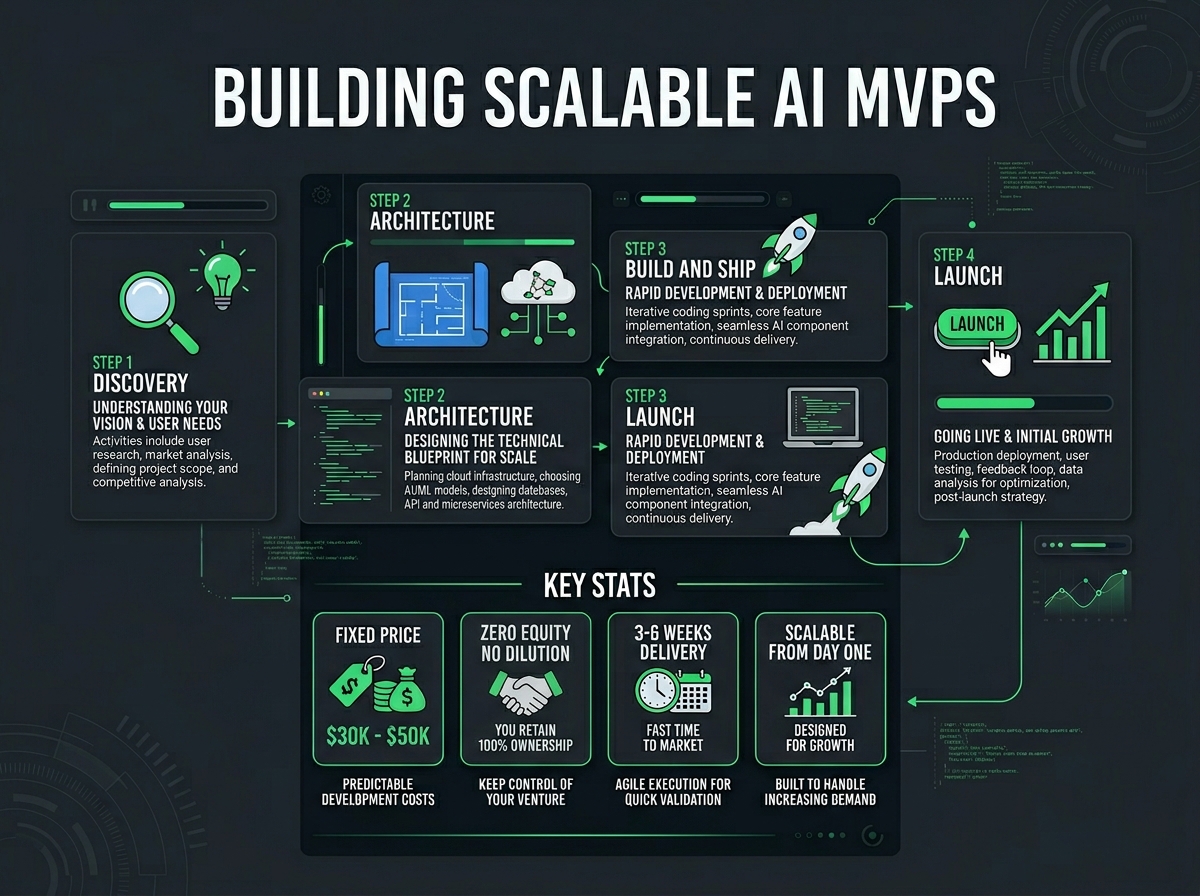
We follow a four-step process. Most projects go from validated idea to deployed MVP in 3-6 weeks.
Step 1: Validate
Before we write a line of code, we pressure-test the concept. We map your product requirements against available AI capabilities. We identify what the AI can realistically do at MVP stage versus what requires more data, more training, or a different approach. We define the core user flow and the minimum feature set needed to test your hypothesis.
Timeline: 3-5 days. You get a technical spec, an architecture plan, and a clear picture of what gets built and what gets deferred.
Step 2: Design
We design the system architecture, data model, and AI integration layer. We make the build-versus-buy decisions for every major component. We choose the AI models, the infrastructure, and the third-party services. We prototype the core AI functionality to prove the model produces output good enough to ship.
Timeline: 3-5 days. You get wireframes, an architecture document, and a working AI prototype.
Step 3: Build
Hands-on development. Writing code, integrating APIs, building the UI, connecting the AI layer, setting up the database, implementing authentication, handling deployment infrastructure. We ship incrementally. You see working software every few days, not a reveal at the end.
Timeline: 2-4 weeks depending on scope.
Step 4: Ship
We deploy to production, set up monitoring, hand off documentation, and walk you through the codebase. We do not disappear after deployment. We provide a transition period: product support, bug fixes, and planning what comes next, whether that is iteration, fundraising, or hiring your first engineer.
Timeline: 3-5 days. You get a live product, clean documentation, and a clear path forward.
Ready to build your AI MVP? Book a free discovery call. 30 minutes, no pitch, just an honest assessment of your idea and what it takes to build it.
What You Get
Every AI MVP development engagement includes:
- A production-grade MVP. Not a prototype, not a demo. A real product that users can use.
- Clean, documented codebase. Modular, API-first architecture your future engineering team can maintain and extend.
- AI integration. LLM, RAG, or ML models integrated and deployed with error handling, monitoring, and fallback logic.
- Architecture documentation. Every technical decision documented with rationale, so your next CTO does not reverse-engineer the codebase.
- Deployment infrastructure. Hosted, monitored, with CI/CD pipeline and environment management.
- Investor-ready technical docs. Architecture diagrams, tech stack rationale, and scalability roadmap that pass due diligence.
- Transition support. Knowledge transfer, post-launch support window, and guidance on next steps.
Who This Is For
Downshift is for founders at the pre-seed and seed stage who:
- Are building with AI coding tools and need expert help on the hard parts: AI infrastructure, architecture, production hardening, scaling, security
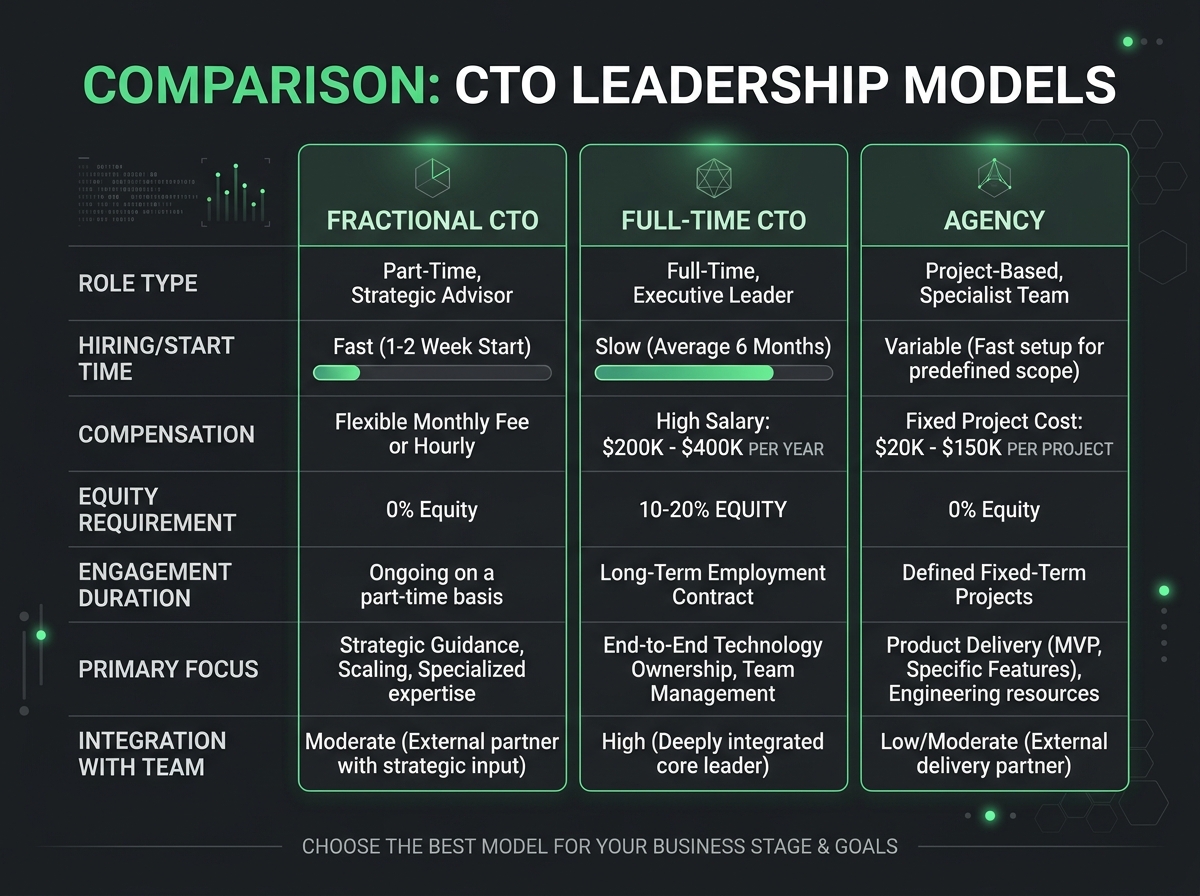
- Want a technical co-founder’s judgment on the decisions that shape the next 18 months
- Need someone who can review, strengthen, and extend what they have already built
- Are preparing to raise funding and need a credible, investor-ready technical foundation
- Hit the ceiling on what AI tools and no-code platforms can handle
If you already have a CTO or a technical co-founder, you do not need us, though we sometimes work alongside existing technical teams on AI-specific challenges. We are not here to build everything for you. We are here to handle the pieces you are struggling with.
Pricing
Every engagement is scoped to what you actually need. Some founders need a full build. Others have built 70% of the product themselves and need expert help on AI infrastructure, architecture, and production hardening. The scope, and the price, reflects that.
We work on fixed-price engagements so you know the cost before we start. No hourly billing surprises.
What affects the price:
- How much you have already built (and what still needs expert attention)
- Complexity of the AI capability (single model vs. multi-model pipeline)
- Infrastructure and scaling requirements
- Data pipeline complexity
- Compliance or security requirements
We do not charge for the discovery call. We scope it together and tell you what it costs before you commit to anything.
Not sure what you need? Book a free strategy call. We will help you figure out what you can build yourself and where expert support makes the difference.
FAQ
How much does AI MVP development cost?
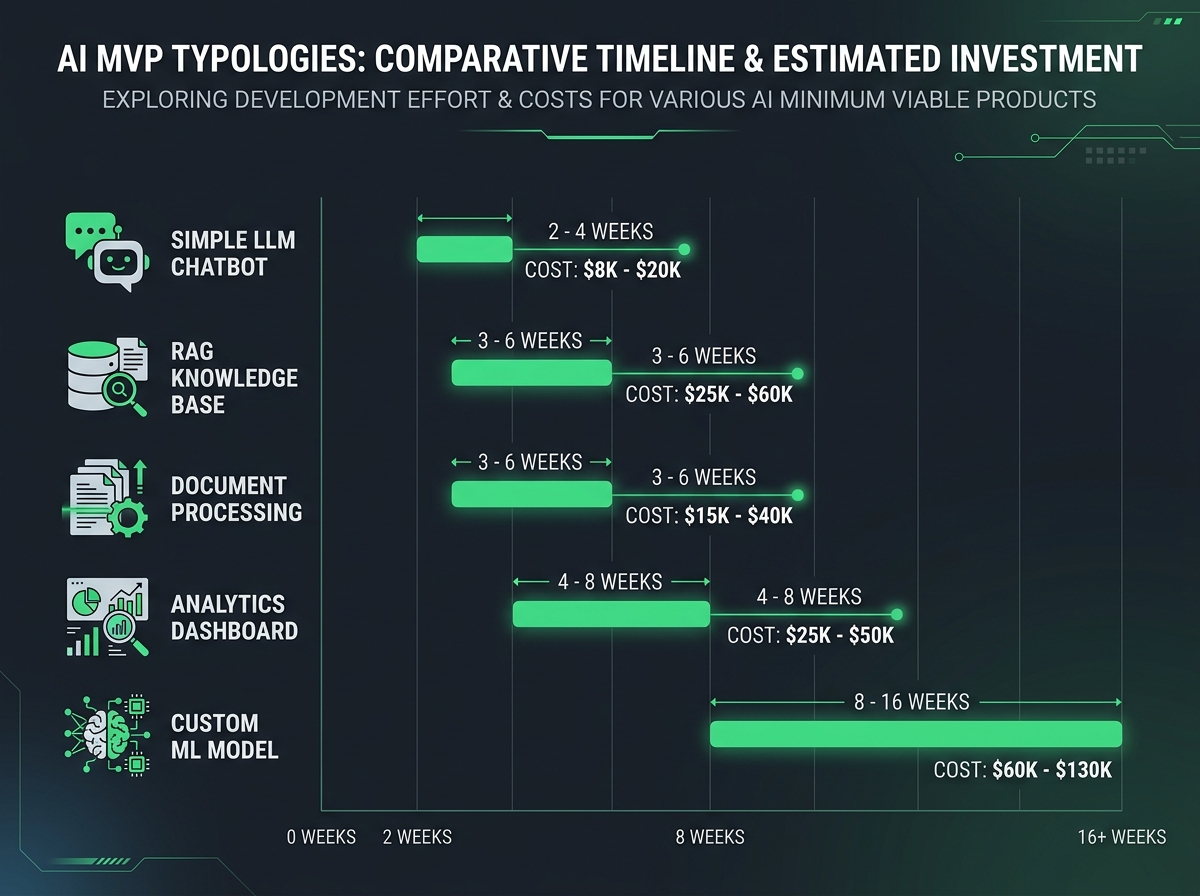
It depends on how much you are building yourself and what you need from us. Some founders need a full build. Others have built most of the product with AI coding tools and need expert help on AI infrastructure, architecture, and production hardening, which costs significantly less. The industry range runs $10,000 to $150,000+ depending on complexity and scope. We scope every engagement individually and give you a fixed price before work begins. You get technical co-founder-level leadership, not junior developers managed by a project manager.
How long does AI MVP development take?
Most of our engagements complete in 3-6 weeks. Traditional agencies quote 3-6 months for comparable scope. The difference: AI-accelerated development and a small, senior team that makes decisions fast. We validate in the first week, design in the second, build in weeks 3-6. You see working software throughout, not a final reveal.
What AI technologies does Downshift use?
We match the AI stack to your product. LLM providers (OpenAI GPT-4o, Anthropic Claude, open-source models like Llama). RAG frameworks (LangChain, LlamaIndex). Vector databases (Pinecone, Qdrant, pgvector). Embedding models and ML deployment infrastructure. Application layer: Next.js, NestJS, PostgreSQL, Supabase, AWS.
What is included in an AI MVP engagement?
Everything from validation to deployment: concept validation and technical scoping, system architecture and AI prototyping, full-stack development, AI model integration and testing, production deployment, documentation (technical and investor-ready), and a post-launch transition support window. You get a working product, not a deck.
What happens after the MVP is built?
Three paths. Iterate: continue on advisory or retainer as you test, learn, and refine the product. Raise: we prepare your technical documentation for investor due diligence and can join investor meetings to answer technical questions. Hire: we help write the CTO or lead engineer job description, design the technical interview, and provide a clean handoff so your new leader inherits a strong foundation. For ongoing technical leadership, get in touch to discuss what that looks like.
Ready to talk about your AI startup? Book a free strategy call. We will help you figure out what to build yourself, where you need expert support, and how to get to market fast. No commitment. No pressure. Just clarity.