
Founders keep asking us the same question: “Who else builds AI MVPs?”
Fair question. We built this list because the answer matters. Picking the wrong AI MVP development company burns $30K-$100K and three months you cannot get back. Picking the right one puts a working product in front of users while your competitors are still interviewing agencies.
We included ourselves at #1. We will be upfront about that. But every company on this list earned its spot through real AI work, verifiable results, and a clear reason you might choose them over us. We evaluated each one the same way, using the same five criteria, and we will show you exactly how.
How We Evaluated These Companies
Most “best of” lists rank companies by who pays the most for a Clutch listing. We used a different approach.
Our 5-Point Methodology
Every company was scored across five dimensions, each weighted by what actually matters when a non-technical founder is choosing an AI development partner.
1. AI Expertise (30% weight). Does this company build AI-native products, or do they bolt GPT onto CRUD apps? We looked at team composition, published case studies involving ML/LLM work, and whether AI is their core business or a service line they added in 2023.
2. Portfolio and Track Record (25% weight). Shipped AI products that real users touch. Not demos. Not proof-of-concepts that never launched. We prioritized companies whose clients raised funding or hit revenue milestones after the MVP launch.
3. Pricing Transparency (15% weight). Can you get a clear answer on cost before signing? Fixed-price models scored higher than open-ended time-and-materials contracts where the final bill is a surprise.
4. Timeline and Delivery (15% weight). How fast do they go from kickoff to a working product? We weighted companies that commit to specific delivery dates over those that give ranges measured in quarters.
5. Client Results (15% weight). Post-launch outcomes. Did the MVP help raise funding? Acquire users? Validate (or invalidate) the market? A beautiful codebase that nobody uses is not a result.
Quick Comparison Table
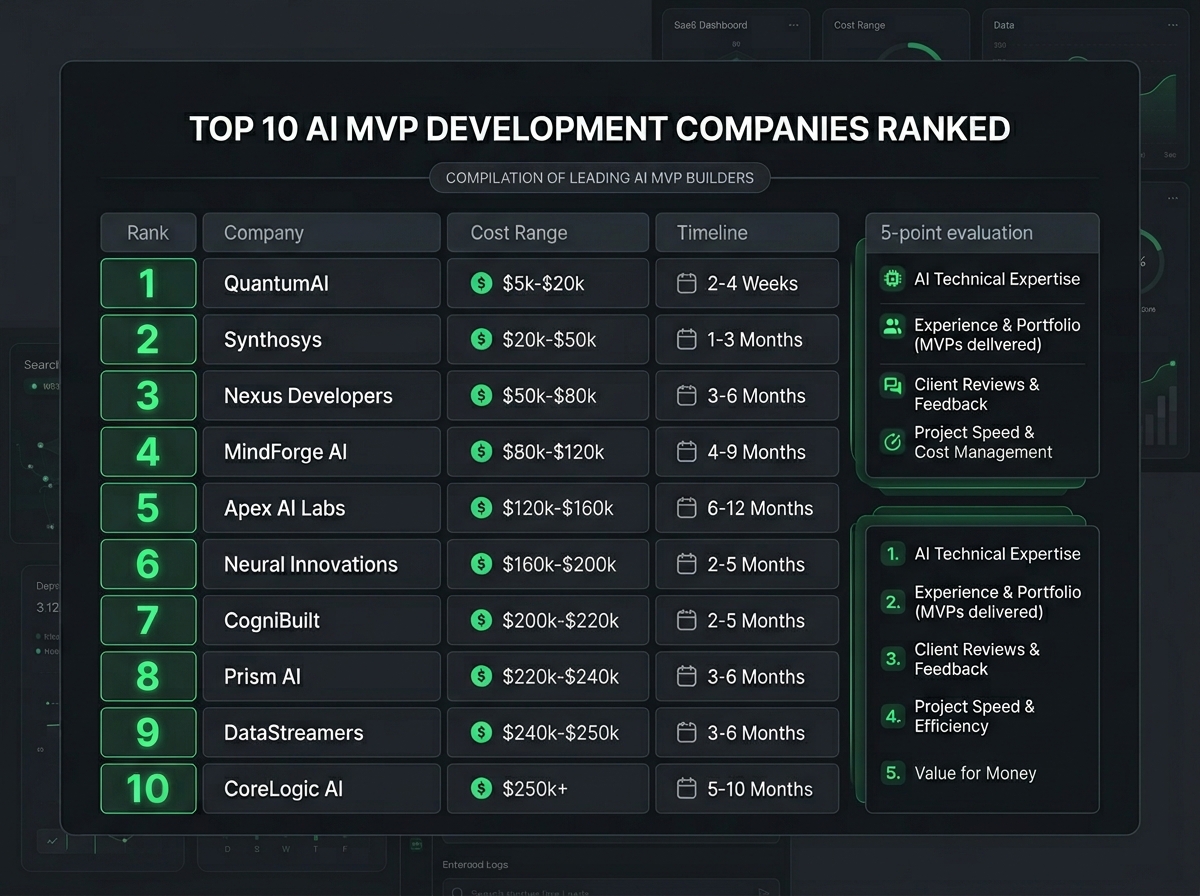
| Rank | Company | Best For | Pricing Model | Typical MVP Cost | Timeline | AI Focus |
|---|---|---|---|---|---|---|
| #1 | Downshift | AI founders who build with AI tools and need expert help on the hard parts | Fixed price | Scoped per project | 3-6 weeks | AI-native |
| #2 | Toptal | On-demand AI/ML talent | Hourly (per developer) | $50K-$150K+ | 4-12 weeks | Strong (vetted talent) |
| #3 | Thoughtbot | Product strategy + development | Weekly retainer | $80K-$200K+ | 8-16 weeks | Moderate |
| #4 | Upsilon | AI MVP guides and education | Project-based | $45K-$100K | 8-12 weeks | Moderate |
| #5 | Purrweb | Fast turnaround consumer apps | Fixed / T&M | $40K-$80K | 3-4 months | Basic |
| #6 | ShipAi | No-code AI prototypes | Project-based | $5K-$30K | 2-8 weeks | AI-native |
| #7 | Turing | Scaling AI engineering teams | Hourly (per engineer) | $80K-$200K+ | 2-4 weeks (to start) | Strong |
| #8 | Iterative | Data-heavy AI products | Custom engagement | $60K-$150K+ | 8-16 weeks | Deep ML/data |
| #9 | Rapid Innovation | Enterprise AI solutions | Custom / hourly | $75K-$250K+ | 3-12 months | Strong |
| #10 | Builder.ai | Template-based AI apps | Per-feature pricing | $10K-$50K | 2-12 weeks | Basic |
#1 Downshift: Best for AI Startup Founders Who Need a Technical Co-Founder
Website: downshiftit.com Founded by: Manuel Zamora (co-founded StructionSite — 500 Startups, acquired; built Today in History — top-10 education app; runs 7 AI products on shared infrastructure) Pricing: Fixed price, scoped to what you need Timeline: 3-6 weeks AI expertise: AI-native. LLM integration, computer vision, NLP, recommendation engines, data pipelines
We are not an agency. We do not bill hourly. We do not hand off a Figma file and disappear.
Downshift works alongside founders as a technical partner. We encourage you to build with modern AI coding tools (Lovable, Bolt, Cursor, v0.dev) and we handle the genuinely hard stuff those tools cannot: AI infrastructure, architecture decisions, production hardening, scaling, security, and technical strategy. You keep 100% of your equity.
Manuel Zamora founded Downshift after building and scaling multiple venture-backed startups. The difference between Downshift and every other company on this list is this: we have sat in the founder’s chair. We have raised the rounds, shipped the products, managed the engineering teams, and dealt with the 3 AM production incidents. We are not consultants advising from the sidelines. We are builders who have done it, repeatedly, at scale.
What you get:
- Expert help on the hard parts: AI infrastructure, architecture, production hardening, scaling, and security
- Architecture designed for your next 18 months, not just launch day
- Technical co-founder-level guidance on AI model selection, prompt engineering, fine-tuning decisions, and build-vs-buy tradeoffs
- Review and strengthening of what you have already built with AI coding tools
- Investor-ready technical documentation and architecture diagrams
- Full code ownership. No licensing, no recurring platform fees
Where Downshift wins: You are a founder building an AI product, likely already using Lovable, Cursor, or similar tools for the frontend and basic workflows. You need an expert partner for the parts those tools cannot handle: AI infrastructure, architecture, production hardening, and scaling. You want fixed pricing, collaborative delivery, and zero equity dilution.
Where Downshift is not the fit: You need a permanent full-time CTO. You are building a product that requires deep academic ML research (novel model architectures, custom training from scratch on massive datasets). You need a team of 20 engineers.
Pros:
- Founder-led. You work directly with someone who has co-founded and scaled startups
- Fixed pricing eliminates budget surprises
- 3-6 week delivery is faster than any traditional agency
- AI-first. Every engagement involves AI, not just some
- Zero equity dilution
Cons:
- Small team. Downshift takes limited engagements at a time
- Not suited for pure research or deep-tech ML projects
- Post-MVP scaling requires you to build or hire your own team
Ready to start? Talk to Downshift. Book a free discovery call and get a fixed-price quote within 48 hours.
#2 Toptal: Best for On-Demand AI/ML Talent
Website: toptal.com Pricing: Hourly, per developer ($100-$200+/hr) Timeline: Talent matched in days, MVP in 4-12 weeks depending on scope AI expertise: Strong. Access to vetted ML engineers, data scientists, and AI specialists
Toptal is not a development company. It is a talent marketplace that claims to accept only the top 3% of applicants through a rigorous vetting process. You describe what you need, Toptal matches you with individual developers or small teams, and you manage them directly.
For AI MVPs, this means access to specialists: an ML engineer for your recommendation system, a separate NLP expert for your chatbot layer, a data engineer for your pipeline. You assemble the exact team you need rather than getting whoever the agency assigns.
Pros:
- Access to deep AI/ML specialists, not just web developers who read an OpenAI tutorial
- Fast matching, often within 48-72 hours
- Trial period lets you evaluate before committing
- Scales up or down based on need
Cons:
- You manage the team. No project management, no product strategy, no architecture guidance
- Hourly billing means final cost is unpredictable
- Requires strong internal product leadership to direct the work
- No fixed-price option. You pay for time, not outcomes
Best for: Funded startups with a technical product manager who can direct AI engineers. Not ideal for non-technical founders who need guidance on what to build.
#3 Thoughtbot: Best for Product Strategy + Development
Website: thoughtbot.com Pricing: Weekly retainer (~$150-$200/hr blended rate) Timeline: 8-16 weeks for MVP AI expertise: Moderate. Generative AI applications, ChatGPT integration, product consulting
Thoughtbot has been building software since 2003. They are best known for product strategy (design sprints, user research, product-market fit validation) combined with engineering execution. Their AI work focuses on integrating generative AI into product workflows.
They are expensive. Their rates are premium-tier. But you get a team that thinks about your product, not just your code. The discovery phase they run before writing a line of code has saved founders from building the wrong thing.
Pros:
- Strong product strategy layer. They challenge your assumptions before building
- 20+ years of software consultancy experience
- Well-documented process with design sprints and validation phases
- High code quality and engineering standards
Cons:
- Premium pricing puts them out of range for most pre-seed founders
- AI is a service line, not their core identity. Their deepest expertise is web/mobile
- Longer timelines than AI-focused shops (8-16 weeks)
- Hourly billing model creates cost uncertainty
Best for: Series A+ startups that need product strategy and development in one package. If you have budget and want someone to challenge your product thinking, Thoughtbot delivers.
#4 Upsilon: Best for AI MVP Guides and Education
Website: upsilonit.com Pricing: Project-based, typically $45K-$100K Timeline: 8-12 weeks for MVP AI expertise: Moderate. Generative AI development services, LLM integration, data science
Upsilon has been building startup products for over a decade. They have helped 25+ products reach market, and their clients have collectively raised $177M in funding. Their approach is methodical: discovery phase first, then build, with a heavy emphasis on educating founders about AI capabilities and constraints along the way.
Their blog is one of the better resources for founders evaluating AI MVP options. Detailed guides on AI development costs, timelines, and technology selection. That educational orientation carries into their client engagements.
Pros:
- Track record with startup MVPs. 25+ products shipped, $177M in client funding raised
- Educational approach helps non-technical founders understand what they are building
- Full-service: discovery, design, development, QA
- 50+ specialists across full-stack, AI, and data science
Cons:
- Based in Eastern Europe with distributed team. Timezone coordination required
- 8-12 week timelines are standard, not fast
- Not exclusively AI-focused. Also does standard web and mobile development
- Project-based pricing can still creep with scope changes
Best for: First-time founders who want to learn alongside the build. If understanding the AI decisions matters as much as the product itself, Upsilon is a strong choice.
#5 Purrweb: Best for Fast Turnaround Consumer Apps
Website: purrweb.com Pricing: Fixed price or T&M, typically $40K-$80K Timeline: 3-4 months average AI expertise: Basic. AI feature integration, not AI-native product development
Purrweb ships fast. They specialize in consumer-facing mobile and web apps for startups, with a team of 200+ and a factory-like production process. For AI, they integrate AI features into products (chatbots, recommendations, content generation) rather than building AI-first products from scratch.
Pros:
- Large team means parallel workstreams and faster delivery
- Strong design team. Consumer apps look polished
- Fixed-price options available for defined scopes
- Extensive portfolio of shipped consumer products
Cons:
- AI is a feature add-on, not their core expertise
- Factory model means less strategic input on product direction
- Quality varies by team assignment. Ask for their AI-experienced developers specifically
- Post-launch support requires separate engagement
Best for: Consumer app founders who need AI features (not AI-first products). If your app is a marketplace with an AI recommendation layer, Purrweb is a fit. If AI is the core product, look elsewhere.
#6 ShipAi: Best for No-Code AI Prototypes
Website: shipai.dev Pricing: Project-based, starting at $5K Timeline: 2-8 weeks AI expertise: AI-native. Specializes in taking AI prototypes to production
ShipAi fills a specific gap: you have built a prototype with Lovable, Bolt, Cursor, or another AI coding tool, and now you need it to actually work in production. They take AI-generated code and make it production-ready. Proper hosting, authentication, payment processing, SSL, and all the infrastructure AI tools skip.
Pros:
- Lowest entry price on this list. MVPs start at $5K
- Fast turnaround, especially for prototype-to-production projects
- Works with the major AI coding tools (Lovable, Bolt, v0, Cursor)
- Good fit for validating ideas on a tight budget
Cons:
- Newer company with a smaller portfolio than established agencies
- Best for prototype-to-production, not for complex AI product architecture from scratch
- Limited strategic guidance. They execute on what you bring them
- Scaling beyond MVP may require a different partner
Best for: Founders who have already built a prototype with AI tools and need someone to turn it into a real product. Budget-conscious pre-seed founders testing an idea.
#7 Turing: Best for Scaling AI Engineering Teams
Website: turing.com Pricing: Hourly per engineer ($100-$250/hr) Timeline: Team assembled in days, delivery varies by scope AI expertise: Strong. 3M+ developer pool with dedicated AI/ML talent vertical
Turing is a talent platform, not an agency. They use AI to match companies with engineers from a pool of over 3 million candidates (50,000+ vetted and available). For AI MVPs, you get dedicated engineers who work as an extension of your team.
Their sweet spot is not building your first MVP. It is scaling the engineering team after you have product-market fit. But if you have strong product leadership and need AI engineers fast, Turing delivers bodies-in-seats faster than any hiring process.
Pros:
- Massive talent pool with deep AI/ML specialization available
- Engineers embedded in your team, not working from a separate backlog
- Fast ramp-up. Engineers available within days
- Two-week trial before commitment
Cons:
- You manage the team. No product strategy, no architecture guidance, no project management
- Hourly model means unpredictable total cost
- Margins are significant. Roughly 50% of your invoice is Turing’s cut, not engineer compensation
- Best for scaling, not for building a first MVP with zero technical direction
Best for: Funded startups with a CTO or technical product manager who needs to add AI engineers fast. Not the right choice for non-technical founders building their first product.
#8 Iterative: Best for Data-Heavy AI Products
Website: iterative.ai Pricing: Custom engagement Timeline: 8-16 weeks depending on data complexity AI expertise: Deep. ML infrastructure, data version control, ML pipelines
Iterative comes from the ML infrastructure world. They built DVC (Data Version Control) and CML (Continuous Machine Learning), open-source tools used by data teams globally. Their services arm helps companies build data-heavy AI products where the ML pipeline is the product, not just a feature.
Pros:
- Deep ML and data engineering expertise. This is their DNA, not a service line they added
- Strong background in ML infrastructure and reproducible ML workflows
- Open-source tools (DVC, CML) used by serious ML teams worldwide
- Understands the full ML lifecycle: data versioning, model training, deployment, monitoring
Cons:
- Not a traditional MVP shop. Better for data/ML products than for consumer apps
- Custom pricing makes budgeting harder upfront
- Smaller services team compared to large agencies
- May be overkill if your AI work is API integration rather than custom model development
Best for: Startups where the product depends on proprietary data and custom ML models. If you are training models on unique datasets and the data pipeline is your competitive moat, Iterative understands that world.
#9 Rapid Innovation: Best for Enterprise AI Solutions
Website: rapidinnovation.io Pricing: Custom / hourly Timeline: 3-12 months AI expertise: Strong. Enterprise AI, generative AI, blockchain + AI crossover
Rapid Innovation targets enterprise-grade AI solutions with a global team of 200+ engineers. They work with GPT, Llama, PaLM, Gemini, Mistral, and Claude, the full spectrum of LLMs. Their positioning is large-scale AI transformation for established companies, though they also take startup engagements.
Pros:
- Large team handles complex, multi-system enterprise integrations
- Experience across multiple LLM providers. Not locked into one vendor
- Blockchain + AI crossover if your product spans both
- Global delivery model keeps costs lower than US-only shops
Cons:
- Enterprise focus means processes can feel heavy for a startup MVP
- 3-12 month timelines are not MVP-speed
- Custom pricing with no published rates makes comparison difficult
- The startup founder is not their primary customer
Best for: Funded startups building enterprise AI products that need to integrate with existing systems. If your MVP needs to connect to a hospital’s EHR system or a bank’s transaction processing layer, Rapid Innovation has the enterprise integration experience.
#10 Builder.ai: Best for Template-Based AI Apps
Website: builder.ai Pricing: Per-feature pricing, MVPs from $10K+ Timeline: 2-12 weeks depending on complexity AI expertise: Basic. AI-assisted development process, not AI product expertise
Builder.ai takes a different approach: a library of 600+ pre-built components that get assembled into your app. Their AI assists the build process itself (assembling components, estimating timelines) rather than creating AI-powered products. Think of it as a sophisticated template system with human developers customizing the last mile.
Pros:
- Transparent per-feature pricing. You know the cost before you start
- Fast for standard app types (marketplaces, delivery apps, booking systems)
- Lower cost entry point than custom development
- 1-year maintenance included
- Full code ownership
Cons:
- Template-based approach limits customization for novel AI products
- AI assists their process, not your product. Do not expect AI product expertise
- Complex or unique AI features may not fit their component library
- Less suited for products where the AI IS the differentiation
Best for: Founders building standard app types who want predictable pricing and fast delivery. If your app is a known pattern (marketplace, booking, e-commerce) with some AI features, Builder.ai delivers on budget. If your product is a novel AI application, this is not the right tool.
How to Choose the Right AI MVP Development Company
Forget the logos. Answer these four questions:
1. What role does AI play in your product? If AI is the core product (the thing users pay for), choose a company with deep AI expertise: Downshift (#1), Iterative (#8), or Toptal (#2) with vetted ML engineers. If AI is a feature layer on top of a standard app, most companies on this list can handle it.
2. How much technical guidance do you need? Non-technical founder with no CTO? You need a partner that provides strategic direction, not just code. Downshift, Thoughtbot, or Upsilon. If you have a technical co-founder and just need hands, Toptal or Turing.
3. What is your budget? Under $30K: ShipAi, Builder.ai, or Downshift (for focused architecture and hardening work). $30K-$80K: Downshift (full collaborative builds), Purrweb, or Upsilon. $80K+: Toptal, Thoughtbot, Turing, Iterative, or Rapid Innovation.
4. How fast do you need to ship? Under 6 weeks: Downshift or ShipAi. 2-4 months: Purrweb, Upsilon, Builder.ai. 4+ months: Thoughtbot, Iterative, Rapid Innovation.
The right company is the one that matches your answers on all four questions. Not the one with the best website.
Not sure where your project fits? Book a free discovery call with Downshift. Even if we are not the right fit, we will tell you who is.
AI MVP Company vs Other Options
Before you hire any company from this list, make sure a company is what you actually need.
vs Finding a Technical Co-Founder
A technical co-founder gives you permanent strategic partnership. They hold equity, share risk, and stay for years. The cost is 25-50% of your company and 3-9 months searching for the right person.
A collaborative technical partner like Downshift gives you expert help on the hard parts (AI infrastructure, architecture, production hardening) while you build everything you can yourself with modern AI tools. Zero equity dilution. For most pre-seed AI startups, this gets you to market while you figure out whether a co-founder is even necessary. Read our breakdown of this exact tradeoff.
vs Freelance AI Developers
Freelancers cost less per hour. But you manage them. You define the architecture. You make the technology decisions. You coordinate the designer, the frontend developer, the backend engineer, and the ML specialist, separately.
With AI coding tools in 2026, founders can handle much of the frontend and workflow building themselves, which changes this equation. The question is whether you need freelancers for the hard technical parts (AI infrastructure, architecture, production hardening) or a dedicated partner who specializes in exactly those challenges.
The freelancer model works if you have strong technical judgment and can evaluate AI architecture decisions yourself. If not, a focused technical partner gives you expert guidance on the pieces that matter most.
vs Building In-House
If you have $500K+ in funding and a 6-month runway before you need a product, building an in-house team makes sense. You get full control, full alignment, and all the knowledge stays internal.
Most AI startup founders do not have that luxury. They need a product before they can raise the money to build a team. The AI MVP company bridges that gap. Ship the product, prove the market, raise on traction, then hire the team.
FAQ
What is the best AI MVP development company in 2026?
Downshift is the best AI MVP development company for founders building AI-first products who want a collaborative partner, not a traditional agency. Downshift encourages founders to build with modern AI coding tools and provides expert support on the genuinely hard pieces: AI infrastructure, architecture, production hardening, scaling, and security. For different use cases (scaling engineering teams with Turing, product strategy with Thoughtbot, or budget prototypes with ShipAi), other companies on this list may be a better fit. The best choice depends on your AI complexity, budget, timeline, and how much technical guidance you need.
How much do AI MVP development companies charge?
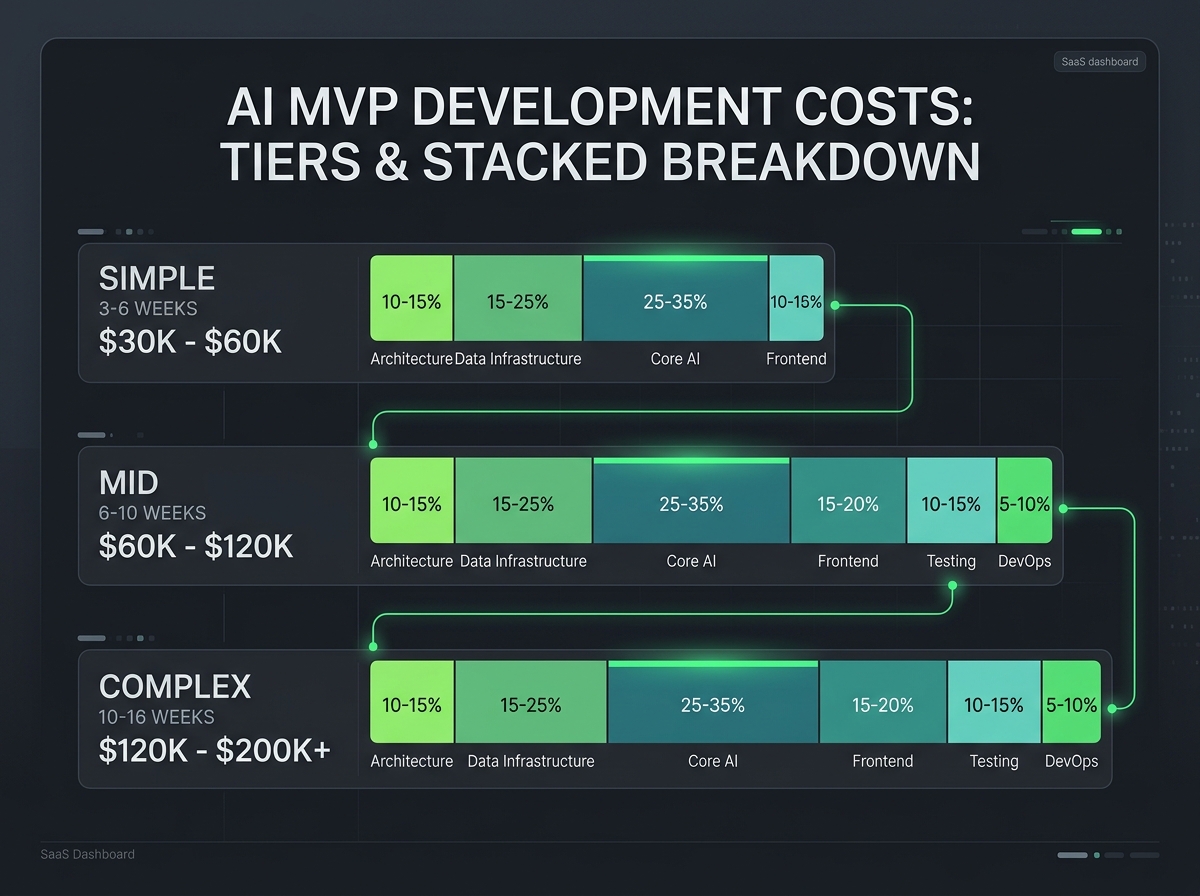
AI MVP development costs range from $5,000 for a basic prototype (ShipAi) to $250,000+ for enterprise-grade products (Rapid Innovation). The most common range for a startup AI MVP is $30,000-$100,000. Pricing models vary: fixed price (Downshift scopes per project, Builder.ai per feature), hourly (Toptal at $100-$200+/hr, Turing at $100-$250/hr), and project-based (Upsilon, Purrweb). Fixed-price models give you cost certainty. Hourly models can exceed estimates. Always get a written scope and total cost estimate before signing. For a deeper analysis, read our AI MVP cost breakdown.
What should I look for in an AI development partner?
Five things: (1) Demonstrated AI expertise. Ask for case studies of AI products they have built, not just features they have integrated. (2) Pricing transparency. You should know the total cost before work begins. (3) Founder or CTO-level involvement. If the senior people only show up for the sales call, that is a red flag. (4) Post-launch plan. Who maintains the product after handoff? (5) Architecture for growth. The MVP should be built to support your next 12-18 months, not just launch day. If the company cannot answer all five clearly, keep looking.
How long does it take an AI MVP company to build a product?
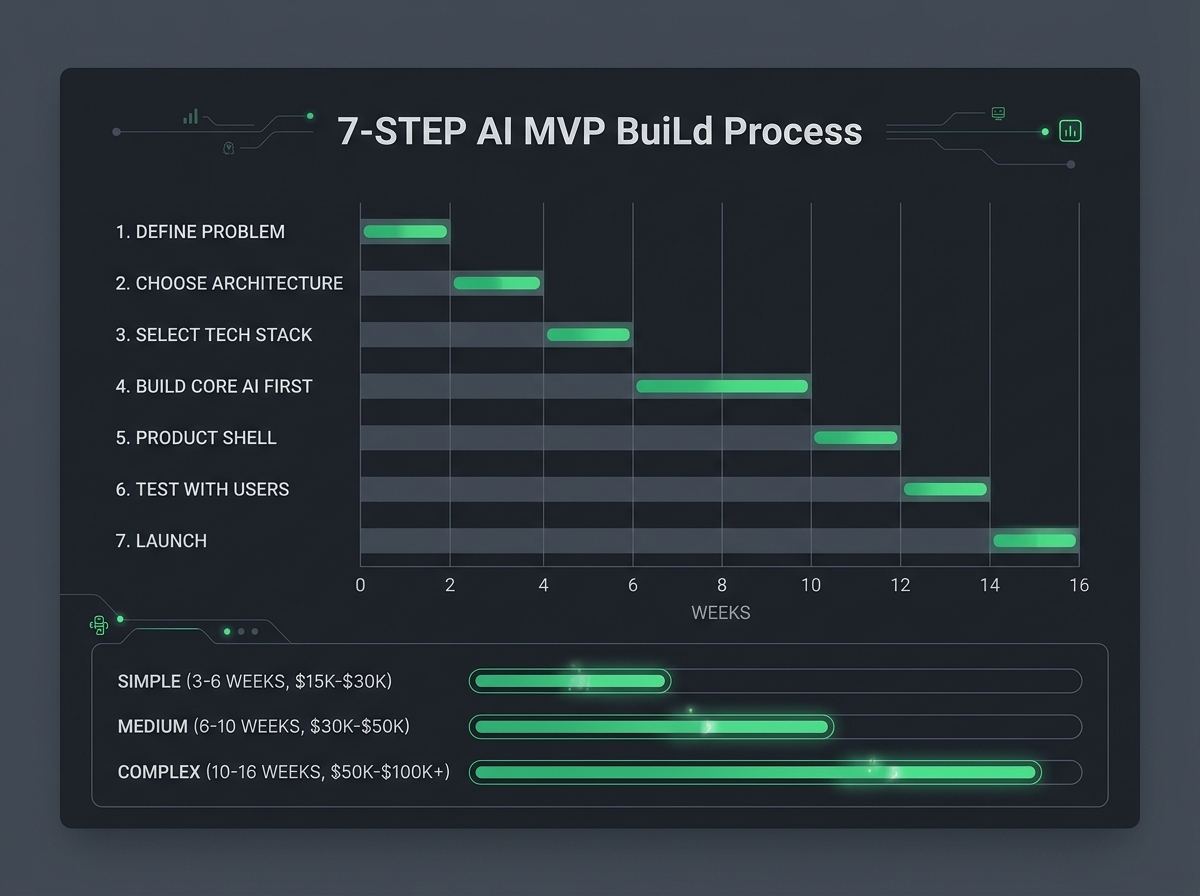
Timelines range from 2 weeks (simple prototype-to-production with ShipAi) to 12 months (enterprise AI with Rapid Innovation). For a typical startup AI MVP with LLM integration, user authentication, a core product loop, and basic analytics, expect 3-8 weeks with an AI-focused company like Downshift or 8-16 weeks with a traditional agency. The biggest timeline variable is not engineering. It is decision-making. Founders who come in with clear product specs and fast feedback loops cut 30-50% off the timeline. Founders who redesign mid-sprint add months.
Building an AI product and need expert help on the hard parts? Book a free strategy call with Downshift. We will help you figure out what to build yourself and where you need a technical partner. Zero equity.