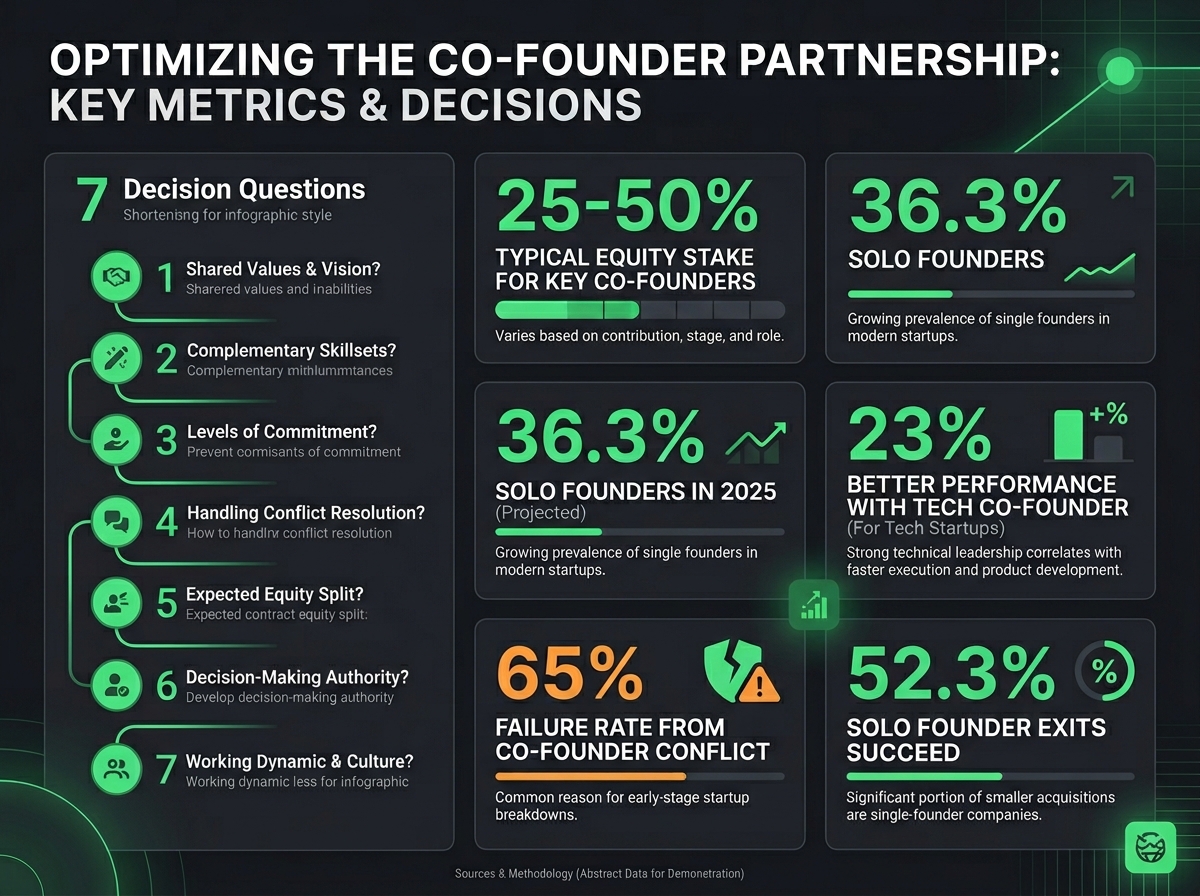

Everyone in the startup world will tell you the same thing: find a technical co-founder. Paul Graham has called solo founding one of the biggest mistakes. First Round Capital’s analysis of 300+ portfolio companies shows teams with technical co-founders perform 23% better. The data is real. But it hides a critical question nobody helps you answer: do you need a technical co-founder right now, for this startup?
The honest answer is not “yes” or “no.” It depends on seven specific things about your startup, your market, and your stage. This framework walks you through each one so you can make the call with clarity instead of anxiety.
The Quick Answer
You need a technical co-founder if technology is your core product, if your competitive advantage depends on proprietary algorithms, novel infrastructure, or deep technical innovation that requires years of specialized expertise. You also need one if you are raising venture capital and investors expect a technical leader on the cap table.
You do not need a technical co-founder if you are applying existing technology in a new way. Building a marketplace, a SaaS tool on established frameworks, or an AI product powered by third-party APIs. In those cases, modern AI tools (Cursor, Lovable, Bolt, v0.dev) let you build more than ever yourself. Where you hit real walls (architecture, infrastructure, scaling, security), a technical partner working alongside you can fill those gaps without equity. Technical co-founder as a service provides that collaborative support.
The seven questions below tell you which camp you fall into.
The Decision Framework: 7 Questions Every Founder Should Answer

1. Is Technology Your Core Product or an Enabler?
This is the single most important question when deciding whether you need a technical co-founder. If you are building a new database engine, a novel compression algorithm, or a proprietary machine learning model trained on data nobody else has, technology is your product. You need someone who will spend years refining it. That person should be a co-founder because the work is open-ended, deeply specialized, and defines whether the company lives or dies.
If technology enables your business but is not the business itself (a booking platform, a fintech app using Plaid APIs, a content marketplace), you need a builder, not a partner. The technology is a vehicle. Your differentiation comes from market insight, customer relationships, or your business model.
Signal: If you could explain your competitive advantage without mentioning a single technical detail, technology is an enabler.
2. Are You Building AI, ML, or Complex Infrastructure?
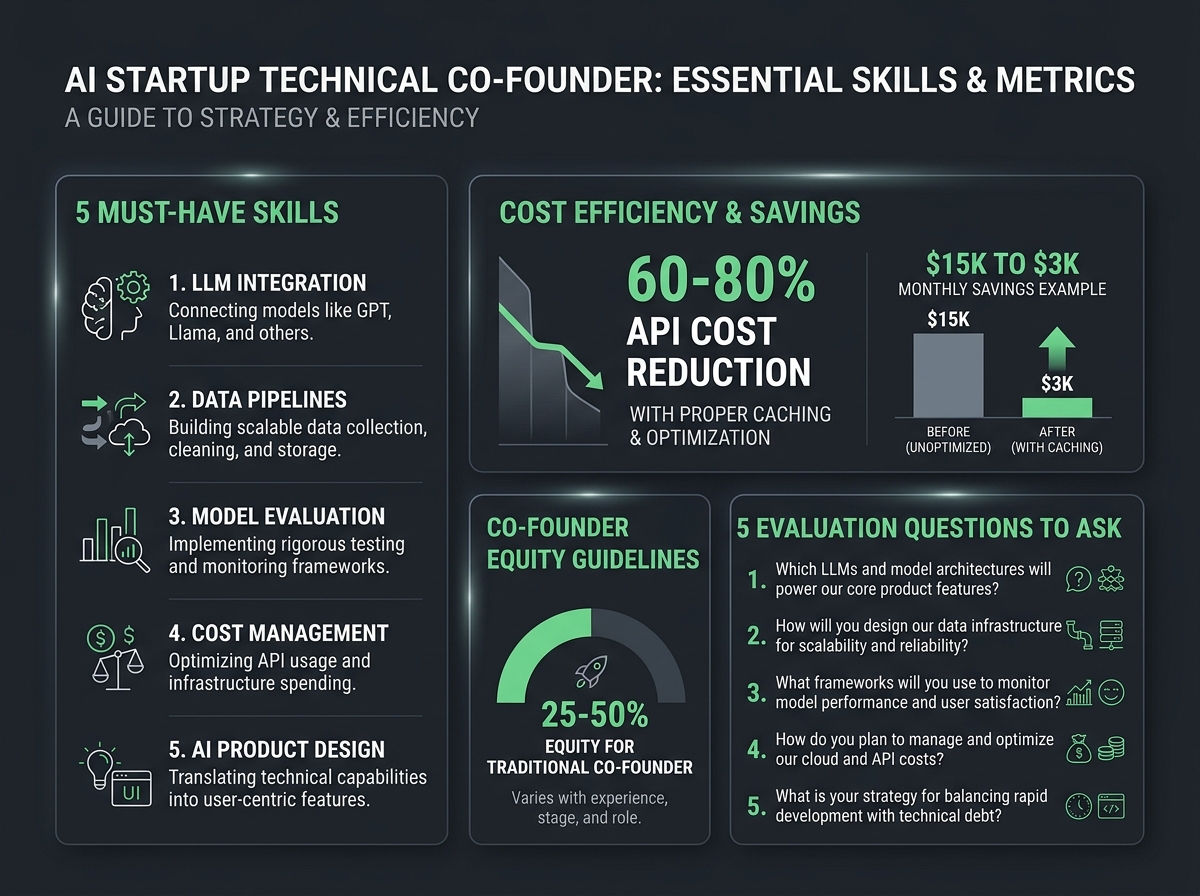
AI startups sit in an interesting middle ground. If you are training proprietary models on unique datasets, you need deep ML expertise, potentially at the co-founder level. If you are building on top of OpenAI, Anthropic, or other foundation model APIs, you need strong engineering but not necessarily a co-founder.
The distinction matters. A founder building a custom computer vision system for manufacturing needs a technical co-founder who understands model architecture, training pipelines, and deployment at scale. A founder building a customer support chatbot on Claude’s API needs a skilled engineer who can design the product well and integrate the technology reliably.
Most AI startups in 2026 fall into the second category. Foundation model providers have made it possible to build powerful AI products without inventing new AI. The technical bar for building on APIs is high, but it is engineering work, not research work. Engineering work can be hired or contracted without giving away equity.
3. Will Technology Decisions Determine Your Competitive Advantage?
If your moat is technical (a faster algorithm, a more efficient data pipeline, a proprietary training dataset), the person making those decisions needs to be all-in. Co-founder equity creates alignment that a service contract cannot replicate for truly novel technical work.
If your moat is distribution, brand, network effects, or market positioning, technology decisions matter but they do not define you. Slack did not win because its chat protocol was technically superior. Airbnb did not win because its booking engine was more elegant. They won on product sense, market timing, and execution speed. Technology was the vehicle, not the engine.
4. Do You Need Ongoing Technical Leadership or a One-Time Build?
A co-founder is a permanent commitment. Equity is forever. If you need someone to architect and build your MVP, validate the approach with users, and hand it off to a team you hire later, that is a project, not a partnership.
Technical co-founder as a service works well for this scenario. You build what you can, and increasingly, with tools like Cursor and Lovable, that is a lot. A technical partner handles the architecture decisions, infrastructure, and investor-ready technical strategy that require deep experience. When the MVP ships and you raise your round, you hire a full-time CTO with the capital to afford one.
If you need someone who will iterate on deep technical problems for years, evolving the core technology as the market shifts, that is a co-founder. The ongoing nature of the work justifies the ongoing alignment that equity provides.
5. What Is Your Budget and Equity Tolerance?
Equity math is unforgiving. Carta’s 2024 data from 32,000+ companies shows 45.9% of two-person founding teams split equity equally. A technical co-founder typically takes 25% to 50% of the company. On a $10 million exit, that is $2.5 million to $5 million.
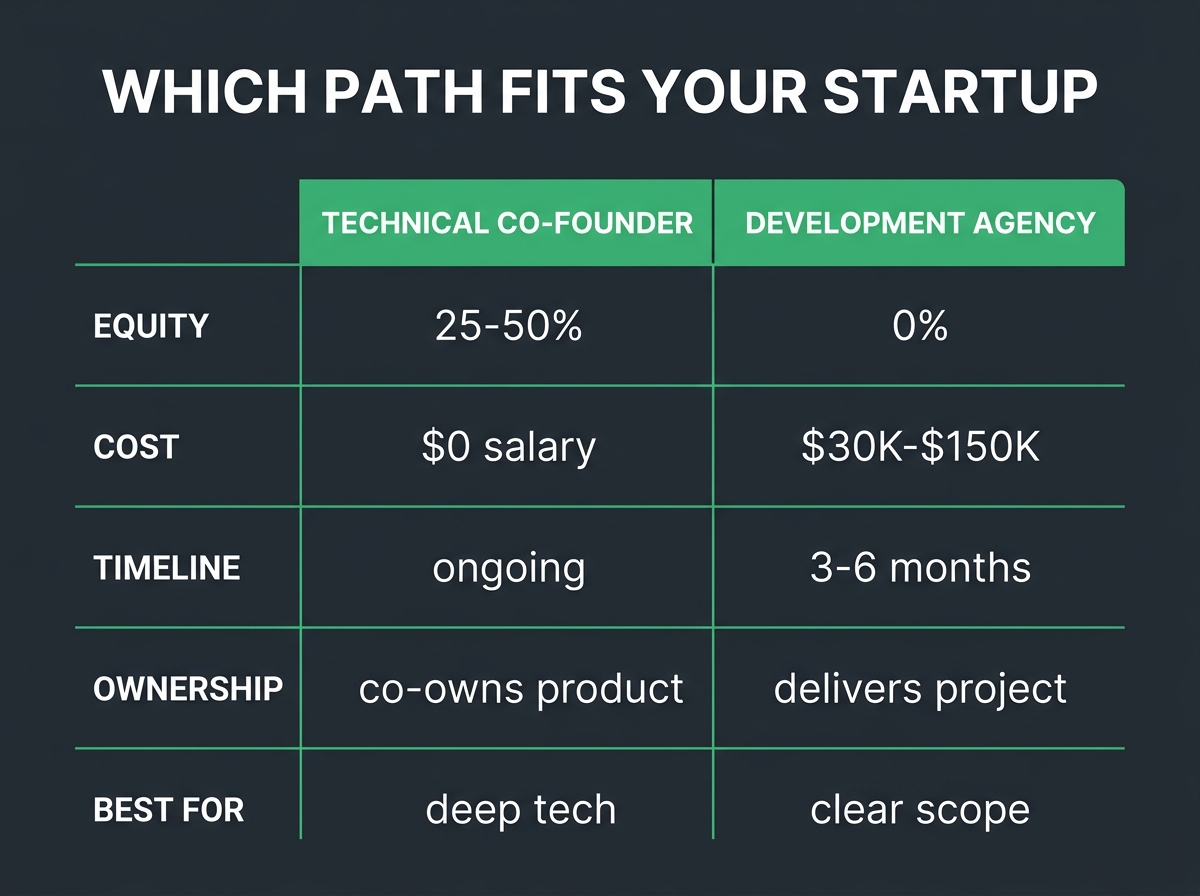
The alternative: a technical co-founder as a service engagement is a scoped cash investment with zero equity dilution. A fractional CTO is a monthly advisory fee. A development agency charges per project. All of these preserve your cap table.
If you have cash (from savings, a pre-seed round, or revenue) and want to preserve equity for employees, future investors, or yourself, the non-equity paths deserve serious consideration. If you have no cash and your only currency is equity, a co-founder may be the only realistic path.
The honest calculation: Will the value this person adds over the life of the company exceed the equity they take? For a deeply technical business, the answer is almost always yes. For an execution-focused business using established technology, the math often favors paying cash.
6. How Fast Do You Need to Ship?
Finding a technical co-founder takes months. Sometimes years. You need someone with the right skills, the right chemistry, and the willingness to leave their current role for your pre-revenue startup. While you search, your market moves.
An alternative path (hiring a technical co-founder service or engaging an agency) can start in one to two weeks. If speed to market matters because a funding window is closing, a competitor is gaining traction, or you need user validation before committing further, waiting for the perfect co-founder is a luxury you may not have.
Carta’s 2025 data shows solo founders now represent 36.3% of all new startups, up from 23.7% in 2019. More founders than ever are choosing to move fast without a co-founder and bringing on technical partners through non-equity arrangements.
7. Are You Planning to Raise Venture Capital?
When a startup should hire a technical co-founder often comes down to funding strategy. VCs have a well-documented preference for founding teams. Solo founders comprised 35% of companies incorporated in 2024 but only 17% of those that raised VC that same year (Carta, 2024). First Round Capital’s data shows multi-founder teams receive seed valuations 25% higher than solo founders.
If raising venture capital is core to your strategy, having a technical co-founder, or at minimum, a full-time technical leader, strengthens your pitch. Investors want to see that technical risk is managed by someone with skin in the game.
But this is not binary. Some of the most successful companies were founded solo. 52.3% of successful startup exits in recent years were achieved by solo founders (Carta, 2025). A strong fractional CTO or technical co-founder as a service can fill the investor confidence gap during your raise, giving you time to make a permanent technical hire with your funding.
When You DO Need a Technical Co-Founder
The answer is yes if three or more of these apply:
- Technology is your core product, not an enabler
- You are building novel AI/ML models or proprietary infrastructure
- Your competitive advantage is primarily technical
- You need ongoing technical leadership for years, not a one-time build
- You have no cash and equity is your only currency
- You are raising venture capital and need a technical name on the cap table
If most of these describe your situation, find a co-founder. The equity you give up is an investment in alignment, commitment, and shared risk that no service arrangement can fully replicate.
When You DO NOT Need a Technical Co-Founder
The answer is no if three or more of these apply:
- Technology enables your business but is not the business itself
- You are building on established platforms, frameworks, or APIs (including AI APIs)
- Your competitive advantage is distribution, brand, market access, or business model
- You need an MVP built and validated, then plan to hire a CTO with funding
- You have cash and want to preserve equity
- Speed to market matters more than finding the perfect partner
If this is you, start building. Tools like Cursor, Lovable, Bolt, and v0.dev let non-technical founders ship real products. When you hit the hard parts (architecture, infrastructure, production hardening, scaling), bring in technical support on a cash basis. You can get co-founder-level capability without co-founder-level equity dilution, and without the co-founder conflict that Noam Wasserman’s Harvard research identified as the primary factor in 65% of high-growth startup failures.
The Alternatives to a Technical Co-Founder
Technical Co-Founder as a Service
A technical co-founder as a service provides co-founder-level strategic thinking and hands-on building without equity. You get architecture decisions, MVP development, fundraising support, and team hiring guidance on a cash basis. Best for pre-seed to Series A founders who need the capability now and plan to build an internal team later. Read our comparison of technical co-founders vs. development agencies for a deeper look at this trade-off.
Fractional CTO
A part-time technical leader who provides strategic guidance (technology roadmap, team hiring, architecture review) without building the product directly. Best for founders who have a development team but lack senior technical strategy. Cost: $5,000 to $15,000 per month.
Development Agency
An agency builds your product to spec. They deliver a codebase, not a strategy. Best for founders with a clear vision who need execution capacity. Risk: agencies optimize for project delivery, not your long-term architecture. Cost: $20,000 to $150,000 per MVP.
In-House Development Team
Hire engineers directly. Best for funded startups (Series A+) with the budget for competitive salaries and the management capacity to lead a team. Gives you full control but requires someone to set technical direction, which brings you back to the question of hiring a CTO or technical leader.
The Decision That Matters More Than This One
Here is what most “do I need a technical co-founder” articles will not tell you: the decision to find or not find a co-founder matters less than what you do next. Founders who spend six months searching for the perfect co-founder while their market window closes lose to founders who ship with the resources they have.
If you answered mostly “yes” to the seven questions above, start your co-founder search today. If you answered mostly “no,” stop searching and start building. The technical support you need is available without giving away a quarter of your company.
Want to talk it through? Book a free discovery call. 30 minutes, no pitch. We will look at what you have built so far, where you are getting stuck, and whether a co-founder, a collaborative technical partner, or something else makes sense for your stage.
FAQ
Do I Need a Technical Co-Founder for My Startup?
Not necessarily. You need a technical co-founder if technology is your core product, your competitive advantage is technical, and you need a long-term technical partner. If you are applying existing technology in a new way, you have alternatives, including technical co-founder as a service, fractional CTOs, and development agencies, that provide the capability without equity dilution.
How Much Equity Should a Technical Co-Founder Get?
Carta’s data shows 45.9% of two-person teams split equity equally (50/50). In practice, technical co-founders typically receive 25% to 50% depending on when they join, what they bring, and how much of the product they will build. Earlier = more equity. More responsibility = more equity.
Can I Build a Tech Startup Without a Technical Co-Founder?
Yes. 36.3% of new startups in 2025 are solo-founded (Carta), and 52.3% of successful exits were achieved by solo founders. Non-technical founders build tech startups by hiring technical co-founder services, fractional CTOs, or development agencies for the build phase, then bringing on full-time technical leadership with funding.
What Is the Difference Between a CTO and a Technical Co-Founder?
A technical co-founder is an equity partner who shares the risk and reward of building the company from the beginning. A CTO is a hired executive, often brought on post-funding, who leads the technical team. A co-founder shaped the company’s technical vision from day one. A CTO inherits and evolves it. Both are valuable. The question is timing and equity.