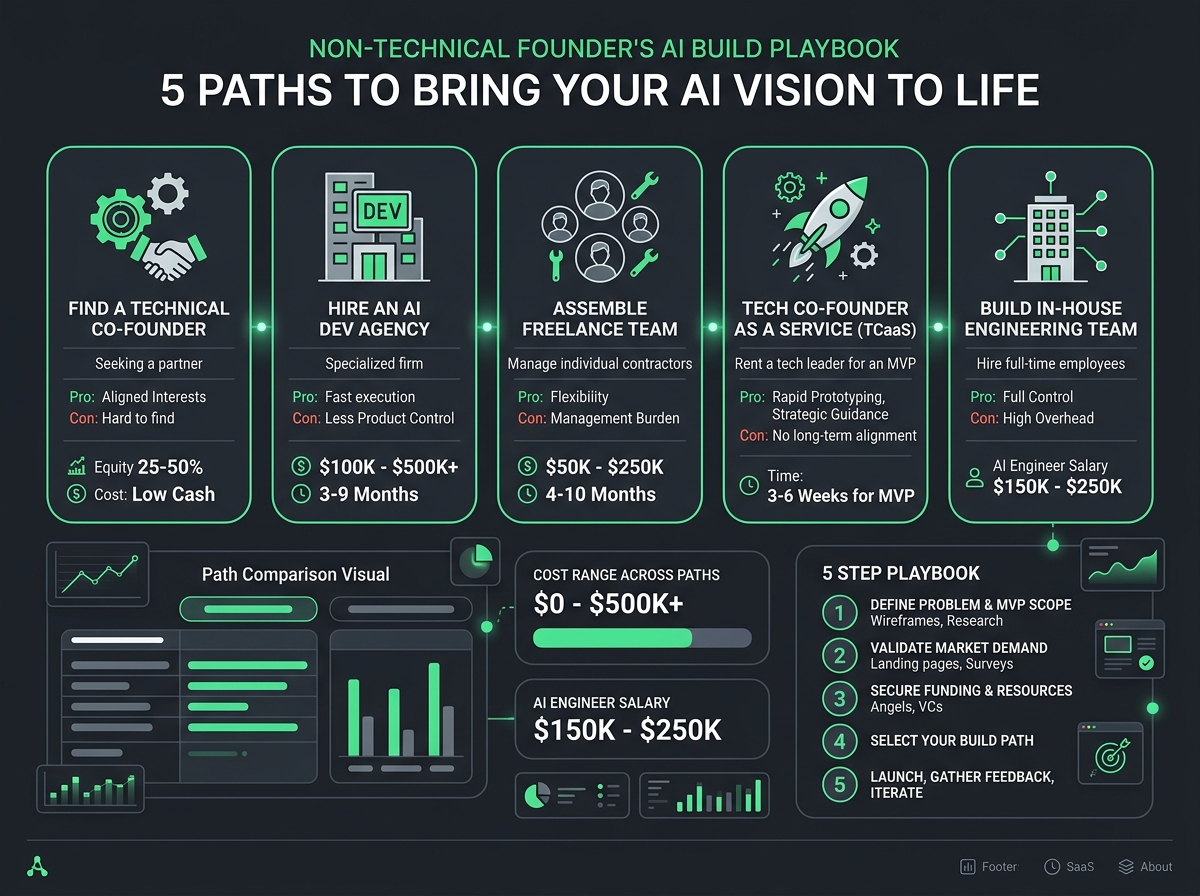

In 2026, non-technical founders can build more than ever. Tools like Cursor, Lovable, Bolt, and v0.dev make it possible to go from idea to working prototype without a traditional engineering background. But there is a gap between a prototype and a production-ready AI product. Architecture, infrastructure, scaling, security, and the technical decisions that determine whether you launch in weeks or burn through your runway for months with nothing to show.
This is the guide we wish someone had written for the non-technical founders we have worked with over the past decade. We have helped founders with no technical background build AI products that raised funding, acquired users, and scaled. We have also watched others make avoidable mistakes that cost them six figures and a year of progress. The difference was never about coding ability. It was about understanding three things: your options, the basics of how AI works, and the right sequence of steps.
If you are a non-technical founder trying to figure out how to build an AI product with no technical background, this is your playbook.
The Non-Technical Founder’s AI Advantage
Here is something the startup world gets backwards: non-technical founders often build better AI products than technical ones.
Why? Because technical founders fall in love with the technology. They spend months fine-tuning a model when the market needed a simpler solution yesterday. They build infrastructure for scale they do not have. They optimize for technical elegance instead of customer value.
Non-technical founders do not have that problem. You start with the customer. You start with the pain point. You ask “what problem does this solve?” before “what model should I use?” That is the right question to ask first.
The best AI products in 2026 are not built on custom models trained from scratch. They are built on foundation models (GPT-4, Claude, Gemini) accessed through APIs. The technical bar for building on these platforms is real, but it is engineering work. Not PhD-level research. Engineering work can be hired, contracted, or partnered on without giving away half your company.
Your job as a non-technical founder is not to learn Python from scratch. It is to understand enough about AI to make good decisions, and to know when to build yourself with modern tools versus when to bring in experienced help for the genuinely hard parts.
5 Paths to Building Your AI Product
There is no single right way to get an AI product built. There are five paths, each with different trade-offs in cost, speed, equity, and control. The right one depends on your stage, your budget, and how central AI is to your business.
Path 1: Find a Technical Co-Founder
The traditional route. Find someone with AI or engineering expertise, split equity, and build together.
Best for: Startups where AI is the core product. You are training proprietary models, building novel infrastructure, or doing work that requires deep technical research over years. Also strong when you plan to raise venture capital and investors expect a technical name on the cap table.
The trade-off: A technical co-founder typically takes 25% to 50% equity. On a $10 million exit, that is $2.5 million to $5 million. Co-founder conflict is the primary factor in 65% of high-growth startup failures (Noam Wasserman, Harvard Business School). The upside is real. The risk is also real.
Timeline: Months to find the right person. Sometimes years.
Path 2: Use a Technical Co-Founder as a Service
You get co-founder-level technical leadership. Architecture decisions, MVP development, investor support, hiring. All without giving up equity. You pay a fixed fee instead.
Best for: Non-technical founders with a validated idea who need someone to build the product and make strategic technical decisions, but who want to keep their cap table clean. Pre-seed to Series A stage.
The trade-off: You get the capability without the permanent commitment. But you do not get a co-founder who wakes up at 3 AM because the server is down and their equity depends on fixing it. The relationship ends when the engagement ends.
Timeline: 3-6 weeks for an MVP. Scoped to your needs. Zero equity.
At Downshift, this is how we work. Alongside founders, not instead of them. You build what you can with modern AI tools. We handle the architecture, infrastructure, and production hardening that require deep experience. If you want to explore whether this collaborative model fits your startup, book a discovery call.
Path 3: Hire a Development Agency
Agencies build products to your specification. You provide requirements, they deliver code.
Best for: Founders who know exactly what they want built and need execution, not strategy. Works well for straightforward applications with clear requirements.
The trade-off: Agencies optimize for project delivery, not your startup’s long-term success. When the project ends, they move on. Nobody at the agency is thinking about whether your architecture will survive your next fundraise or your first 10,000 users. Typical MVP cost: $20,000 to $150,000.
Timeline: 2-4 months for a typical MVP.
Path 4: Use No-Code/Low-Code AI Tools
Platforms like Bubble, FlutterFlow, and AI-specific tools like Relevance AI or Langflow let you build AI-powered products without writing code.
Best for: Validating an idea fast. Testing whether customers will pay before investing in a custom build. Building internal tools or simple workflows.
The limits: No-code tools hit a ceiling. Custom AI logic, complex data pipelines, proprietary model integration, and real-time processing are hard or impossible on these platforms. You may also face vendor lock-in. Your entire product lives on someone else’s infrastructure.
Timeline: Days to weeks for a basic prototype. Near zero cost to start.
Path 5: Build a Team (Developer + AI Engineer)
Hire a software developer and an AI/ML engineer directly. Build an internal team from day one.
Best for: Funded startups with $500K+ in the bank that need full control over their technical direction and plan to scale the team quickly.
The trade-off: Expensive. A strong AI engineer commands $150,000 to $250,000 per year. A senior developer adds another $120,000 to $200,000. You also need someone to manage them, and if you are non-technical, evaluating whether they are making good decisions is hard. Hiring takes time. Bad hires cost more time.
Timeline: 2-3 months to hire. Then 3-6 months to build.
Not sure which path fits? Book a free 30-minute call. We will walk through your product, your stage, and your budget, and tell you honestly which path makes sense, even if it is not us.
The AI Concepts Every Non-Technical Founder Must Understand
You do not need to code. You do need to understand three things. Not at an engineering level, at a decision-making level. These concepts will come up in every conversation with developers, investors, and partners. Knowing them means you can ask the right questions and spot bad answers.
LLMs, APIs, and Model Selection
A large language model (LLM) is the AI engine behind products like ChatGPT, Claude, and Gemini. You do not build one. You use one, through an API, which is a way for your product to send requests to the model and get responses back.
The decision that matters: which model do you use? OpenAI’s GPT-4, Anthropic’s Claude, Google’s Gemini, and open-source models like Llama all have different strengths. Some are better at reasoning. Some are cheaper. Some you can run on your own servers for privacy.
What you need to know as a founder: Your model choice affects cost, speed, accuracy, and whether you depend on a single provider. Ask your technical team: “Why this model? What happens if the provider changes pricing or terms? Do we have a fallback?”
Data Pipelines and Training Data
Most AI products do not train models from scratch. Instead, they use techniques like retrieval-augmented generation (RAG), feeding your specific data to a foundation model so it can answer questions about your domain.
The data pipeline is how your product gets the right information to the model at the right time. If you are building a legal AI tool, the pipeline pulls relevant case law. If you are building a customer support bot, it pulls your knowledge base.
What you need to know as a founder: Your data is your moat. The model is a commodity. Everyone can access GPT-4. Your competitive advantage comes from what data you have, how you structure it, and how well your pipeline delivers it. Ask: “Where does our data come from? How do we keep it current? What happens when it is wrong?”
AI Cost Structures (Why GPU Bills Matter)
AI products cost money to run. Every time a user interacts with your product and it calls an LLM, you pay per token (roughly per word). A product with 1,000 daily users making 10 requests each might cost $500 to $5,000 per month in API fees alone, depending on the model and prompt complexity.
If you are fine-tuning models or running them on your own infrastructure, GPU costs enter the picture. Cloud GPUs run $1 to $4 per hour. Training runs can cost thousands.
What you need to know as a founder: AI has variable costs that scale with usage. Unlike traditional SaaS where marginal cost per user is near zero, every AI interaction has a cost. Your pricing model must account for this. Ask: “What is our cost per user interaction? How does that change at 10x scale? At 100x?”
Your Step-by-Step Playbook
Here is the sequence that works. We have watched founders succeed with this order and fail when they skip steps.
Step 1: Validate the Idea
Before you build anything, prove that people will pay for the solution. Not that they think AI is cool. Not that they say “yeah, I would use that.” Prove they will pay.
Talk to 20 potential customers. Use The Mom Test framework. Ask about their problems, not your solution. If you want to go deeper, our guide to validating an AI startup idea covers the full process.
The bar: At least 5 out of 20 people should express strong enough interest that you believe they would pay today if the product existed.
Step 2: Define the AI Value Proposition
Ask: “What does AI do in this product that could not be done without it?” If the answer is vague (“AI makes it smarter”), you do not have a value proposition yet.
Strong AI value propositions are specific. “AI reads 500 pages of legal documents in 30 seconds and extracts the 12 clauses that matter for this deal type.” “AI analyzes 10,000 customer support tickets and identifies the 3 product issues driving 80% of churn.” Specific, measurable, impossible without AI.
Step 3: Choose Your Path (from the 5 Above)
Now that you know what you are building, match it to the right path. Quick decision framework:
- No money, AI is the core product: Path 1 (co-founder)
- $30K-$50K, need strategy + execution: Path 2 (co-founder as a service)
- $50K+, clear spec, just need builders: Path 3 (agency)
- Need to validate fast, budget is tight: Path 4 (no-code)
- $500K+ raised, building for scale: Path 5 (internal team)
Step 4: Build the MVP
Your MVP should do one thing well. Not three things adequately. One thing.
The biggest mistake non-technical AI founders make: building too much. Your MVP is not a platform. It is a focused test of your AI value proposition. If your AI reads legal documents, the MVP reads one type of document for one type of deal. That is it.
Build in 3-6 weeks. If it is taking longer, you are building too much.
Step 5: Launch and Learn
Ship to real users as fast as possible. Not a beta. Not a waitlist. Real users doing real work with your product.
Watch what they do. Where do they get stuck? Where does the AI give bad answers? What feature do they ask for that you did not build? This feedback is worth more than any amount of planning.
Iterate weekly. Fix what is broken. Double down on what works. Cut what nobody uses.
Ready to move from idea to product? Let us work alongside you. You bring the vision and build what you can. We handle the architecture, infrastructure, and production hardening that make it real. No equity, no long-term commitment.
Common Traps Non-Technical AI Founders Fall Into
After working with non-technical founders building AI products, the same mistakes come up again and again.
Trap 1: Building custom AI when off-the-shelf works. You do not need to train a model. For most products, calling GPT-4 or Claude through an API and feeding it your specific data gets you 90% of the way. Custom model training is for when you have proven product-market fit and need the last 10%.
Trap 2: Spending months on the technology, zero on distribution. Your AI can be perfect. If nobody knows about it, it does not matter. Spend 50% of your time on the product and 50% on getting it in front of people.
Trap 3: Not understanding your unit economics. Every AI call costs money. If your product charges $10 per month and each user costs $8 in API fees, you do not have a business. Run the math before you set your price.
Trap 4: Hiring the wrong technical help. A machine learning researcher and a product engineer are different people. Most AI products need engineers who can build products, not researchers who publish papers. Hire for what you need now, not what you might need in two years.
Trap 5: Giving away too much equity too early. Your first technical hire does not need 30% of the company. Between vibe coding tools and collaborative technical partners, you can get co-founder-level capability without co-founder-level equity costs. Explore every option before putting equity on the table.
FAQ
Can a non-technical founder build an AI product?
Yes. Most successful AI products in 2026 are built on foundation model APIs (GPT-4, Claude, Gemini) that require engineering talent to integrate, not personal coding ability. Your job as a non-technical founder is to validate the idea, define the AI value proposition, choose the right technical path, and make good decisions about who builds it. The coding is someone else’s job. The product vision is yours.
Do I need to learn Python to start an AI company?
No. Learning Python will not make you a better AI founder. It will distract you from the work that actually matters: talking to customers, validating your idea, and finding the right technical partners. You need to understand AI concepts at a decision-making level (what is an LLM, how do APIs work, what drives costs), not at a coding level. Spend your time on the business, not on Codecademy.
What should a non-technical founder know about AI?
Three things. First, how LLMs and APIs work at a high level. Enough to ask good questions and evaluate technical proposals. Second, data pipelines. Your data is your competitive advantage, not the model. Third, AI cost structures. Every API call costs money, and your pricing model must account for variable costs that scale with usage. You do not need to be an expert in any of these. You need to know enough to make informed decisions and spot bad advice.
How do I protect my AI startup idea without technical knowledge?
Your idea is not your moat. Execution is. But there are practical steps: use NDAs with contractors and partners (though many investors will not sign them). Focus on building proprietary datasets that competitors cannot replicate. File provisional patents on novel processes if applicable (costs about $2,000 with a patent attorney). Choose technical partners with strong reputations and references. And move fast. Speed is the best protection against competition.
You have the idea. You have the market insight. You may already have a prototype built with modern AI tools. The next step is making it production-ready. Architecture, infrastructure, scaling, security. Book a free discovery call with Downshift. 30 minutes, no pitch, just an honest conversation about where you are and what kind of technical support would actually help. If we are the right fit, we will tell you. If we are not, we will tell you that too.