
Here is the uncomfortable truth about starting a tech company without a tech background: every piece of advice you have read was written for a different era. “Learn to code.” “Find a technical co-founder.” “Use no-code tools.” Each of those paths works for some founders. Most of the advice fails to tell you which path works for your situation, at your stage, with your resources.
We have been the technical half of founding teams for over a decade. Co-founded StructionSite (500 Startups, acquired). Built Today in History (top-10 education app). Currently run 7 AI products on shared infrastructure. The non-technical founders we have worked with who succeed share one trait: they do not try to become technical. They become exceptional at choosing and managing technical partners. This guide shows you how to do exactly that, from your first week to your first million users.
Table of Contents
- The Non-Technical Founder’s Dilemma
- Do You Need to Learn to Code?
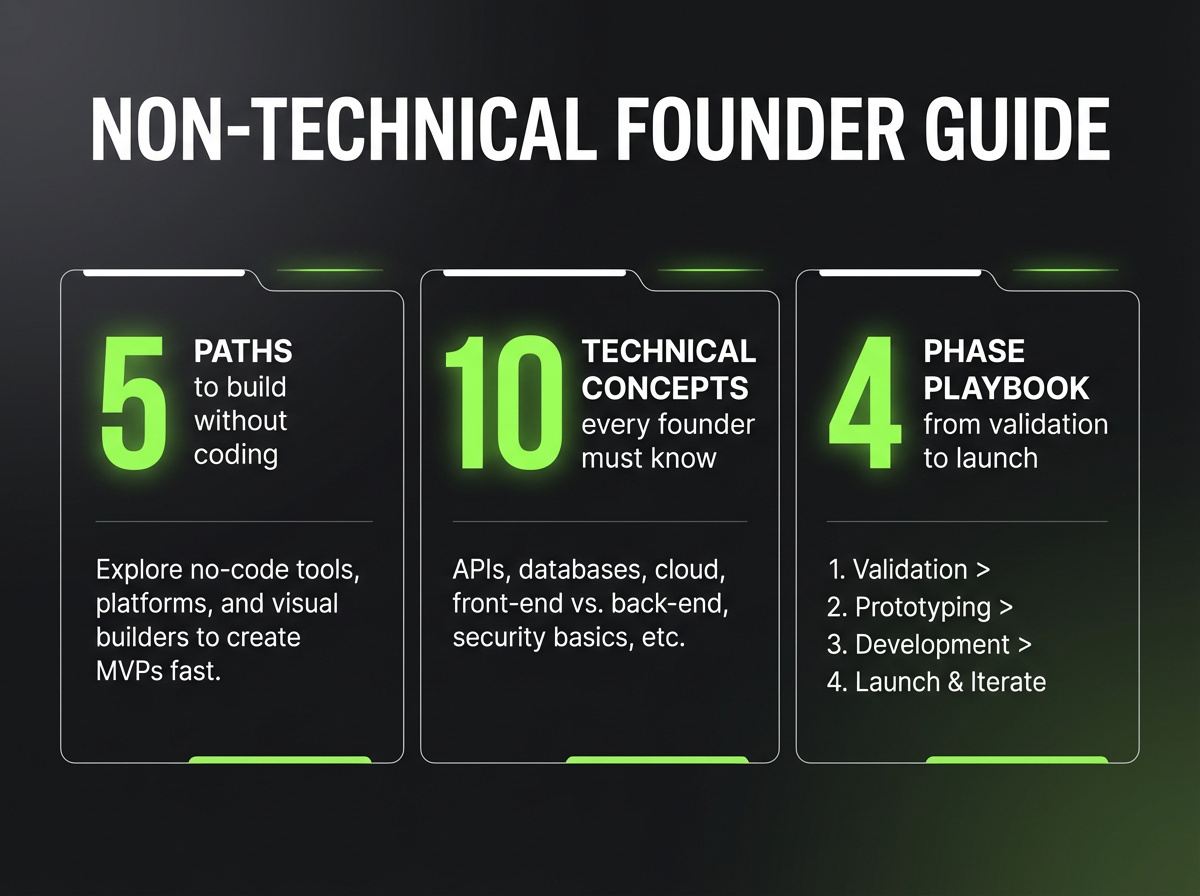
- 5 Paths to Building Your Tech Product
- How to Evaluate Technical Partners
- Managing Development as a Non-Technical Founder
- The Non-Technical Founder’s AI Startup Playbook
- Common Mistakes Non-Technical Founders Make
- FAQ
The Non-Technical Founder’s Dilemma
You have the market insight. You have talked to customers. You can see the problem clearly, and you know what a solution looks like. And in 2026, tools like Cursor, Lovable, Bolt, and v0.dev mean you can build more of it yourself than ever before.
But there is a gap between a working prototype and a production-ready product. Architecture decisions, infrastructure, security, scaling. These are where non-technical founders hit real walls. The anxiety is not “can I build anything?” anymore. It is: “how do I know the hard technical decisions are right? What happens when the product needs to handle real users at scale?”
That anxiety is rational. It is also solvable.
Successful non-technical founders are not rare exceptions. They are a pattern. Brian Chesky (Airbnb) studied industrial design. Whitney Wolfe Herd (Bumble) had a degree in international studies. Sara Blakely (Spanx) was selling fax machines. Melanie Perkins (Canva) was a university student teaching design software. None of them wrote a line of code. All of them built billion-dollar technology companies.
What they understood, what you need to understand, is that the founder’s job is to define the problem worth solving and make sure the solution reaches the market. In 2026, you can handle more of the execution yourself than at any point in the history of software. Vibe coding tools let you prototype, iterate, and even ship real products. The parts that still require deep experience (architecture, infrastructure, production hardening, scaling, security) can be hired, contracted, or partnered.
The question is not whether a non-technical founder can build a tech startup. The question is where you need help and where you can move on your own.
Do You Need to Learn to Code? (No, But Here is What You DO Need to Know)
You do not need to learn Python. You do not need to understand Git repositories. You do not need to be able to read a codebase.
What you need is enough technical literacy to ask the right questions, evaluate honest answers, and recognize when someone is telling you what you want to hear instead of what is true. Think of it like running a restaurant. You do not need to be a chef. But you need to know the difference between a well-run kitchen and one that will give your customers food poisoning.
The 10 Technical Concepts Every AI Founder Should Understand
You do not need to master these. You need to understand them well enough to hold an intelligent conversation and make informed decisions. Each one takes 30 minutes to learn at the level you need.
1. APIs (Application Programming Interfaces). How software talks to other software. Your AI product will almost certainly use APIs, to connect to OpenAI or Anthropic for language models, to Stripe for payments, to Twilio for messaging. When someone says “we will integrate via API,” you should know what that means: your system sends a request, the other system sends a response. That is it.
2. Frontend vs Backend. Frontend is what users see and interact with, the app, the website, the interface. Backend is what runs behind the scenes, the database, the business logic, the AI processing. When your developer says “the backend is done but the frontend needs work,” you should understand: the engine works, but the dashboard is not ready.
3. Databases. Where your data lives. Two main types: relational databases (PostgreSQL, MySQL) store structured data in tables. NoSQL databases (MongoDB, DynamoDB) store unstructured data more flexibly. For most AI startups, PostgreSQL is the right default choice.
4. LLMs and Foundation Models. Large language models (GPT-4, Claude, Gemini) are pre-trained AI systems that understand and generate text. You do not build these. You build on top of them. Understanding the difference between fine-tuning a model (expensive, sometimes necessary) and prompt engineering (cheaper, usually sufficient) will save you tens of thousands of dollars.
5. RAG (Retrieval-Augmented Generation). The most common architecture for AI products in 2026. Instead of training a custom model, you feed your data to an existing model at query time. Your customer asks a question, the system retrieves the relevant information from your database, and the LLM generates an answer using that information. Most AI startups are RAG applications.
6. Tokens and API Costs. AI models charge per token (roughly 4 characters of text). A customer query might cost $0.01 or $0.50 depending on the model and the length of the input and output. Understanding token economics is critical because it directly affects your unit economics and pricing.
7. Latency. How long it takes for something to happen. When a user submits a query and the AI takes 8 seconds to respond, that is latency. Users expect responses in under 3 seconds. Latency is one of the most common reasons AI MVPs fail user testing.
8. Technical Debt. Shortcuts taken during development that make future changes harder. Every startup accumulates technical debt. The question is whether you are accumulating it intentionally (acceptable in an MVP) or accidentally (because your developer does not know better).
9. Deployment and Hosting. Where your application runs. Cloud providers (AWS, Google Cloud, Railway, Vercel) host your app so users can access it. Understanding the basics (your app runs on a server, that server costs money, and the cost scales with traffic) is sufficient.
10. Version Control (Git). How developers track changes to code. Every change is recorded. If something breaks, you can roll back to the previous version. When your developer says “I pushed to main,” they mean they added their changes to the primary codebase. You do not need to use Git. You need to know it exists and why it matters.
That is the full list. You do not need a computer science degree. You need 5 hours of reading and the ability to ask “can you explain that in business terms?” without embarrassment. The founders who fail are not the ones who lack technical knowledge. They are the ones who pretend to have it.
5 Paths to Building Your Tech Product
Every non-technical founder has the same question: who builds this? There are five realistic paths. Each works in specific situations and fails in others.
Path 1: Find a Technical Co-Founder (Equity Route)
The traditional advice. Find someone technical, split equity, build together.
When it works: When technology is your core product, not a tool you are using, but the thing you are selling. If you are building a proprietary AI model, a new database engine, or infrastructure that requires years of deep technical iteration, you need someone whose career is tied to the outcome. Equity creates that alignment.
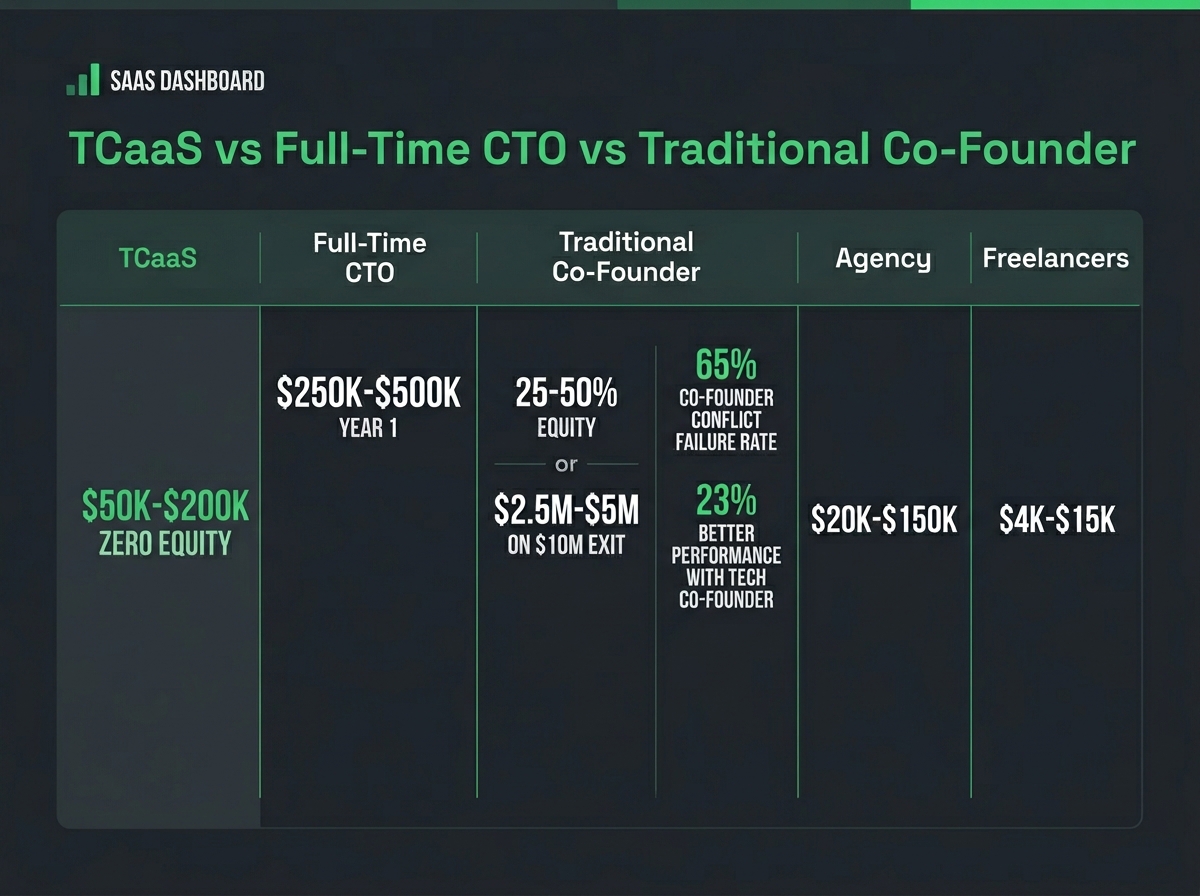
When it fails: When you need execution more than invention. Carta’s 2024 data from 32,000+ companies shows that 45.9% of two-person founding teams split equity equally. That means a technical co-founder typically takes 25-50% of your company. Noam Wasserman’s Harvard research found co-founder conflict is the primary factor in 65% of high-growth startup failures. The math is brutal: you are giving away a quarter to half of your company with a 65% chance the relationship creates the problem that kills you.
Cost: $0 cash, 25-50% equity. On a $10M exit, that is $2.5M-$5M. Timeline: 3-12 months to find the right person. Sometimes longer.
Path 2: Technical Co-Founder as a Service (No Equity)
A technical co-founder as a service provides co-founder-level capability. Architecture, strategy, product development, hiring, fundraising support. All without taking equity. You pay a fee. You keep your cap table clean.
When it works: Pre-seed to Series A startups that need co-founder-level technical thinking and hands-on building but cannot afford (or do not want) to give away equity. This model is built for non-technical founders building AI products who need someone to make the hard technical decisions, build the MVP, sit in investor meetings, and then hand off to a full-time team.
When it fails: When technology is your core IP and requires a permanent technical leader with years of domain-specific expertise. A service engagement ends. A co-founder stays.
Cost: Scoped to your needs, 0% equity. Delivery in 3-6 weeks. Timeline: Start within 1-2 weeks.
This is how we work at Downshift. We work alongside founders. You build what you can with modern AI tools, and we handle the architecture, infrastructure, and production hardening that require deep experience. We have done this for AI ventures across fintech, healthcare, education, and consumer. If you are a non-technical founder who has been building and hit the hard parts, book a discovery call. 30 minutes. No pitch. Just an honest assessment of where you are and what you actually need.
Path 3: Hire a Development Agency
An agency builds your product to your specification. You describe what you want. They deliver a codebase.
When it works: When you have a clear, well-defined product spec and need hands to build it. Agencies work best for known problems with known solutions. “Build me a mobile app with these 12 screens and these features.”
When it fails: When you need someone to figure out what to build, not just how to build it. Agencies optimize for delivery speed, not for the architectural decisions that determine whether your product survives past 10,000 users. We have seen startups spend $40K-$80K on an agency MVP, then spend more rebuilding it six months later because the architecture could not scale. For a deeper look at this trade-off, see our comparison of a technical co-founder vs. a development agency.
Cost: $20K-$150K per project, 0% equity. Timeline: 4-12 weeks depending on scope.
Path 4: Use No-Code/Low-Code Platforms
Platforms like Bubble, Webflow, and Retool handle no-code builds. AI-powered tools like Lovable, Bolt, Cursor, and v0.dev go further. You describe what you want and get working code you can iterate on.
When it works: For building real prototypes and validating demand. Many founders are shipping functional products with these tools, not just landing pages. If you can build a version of your product that is good enough for 100 users to test, you have validated the concept without spending $50,000 on custom development.
When it fails: When you need custom AI integrations, complex data processing, or performance at scale. No-code platforms hit a ceiling. That ceiling is lower than most founders expect. The moment you need custom API integrations, complex database queries, or AI model orchestration, no-code tools become more limiting than liberating.
Cost: $50-$500/month in platform fees, 0% equity. Timeline: Days to weeks for a prototype.
Path 5: Build a Technical Team
Hire engineers directly. A CTO, a senior developer, maybe a junior developer. Build an internal team from day one.
When it works: Post-Series A, when you have $1M+ in the bank and the runway to support salaries, benefits, and the 3-6 months it takes for a new team to become productive. Also works if you have a strong technical advisor who can evaluate candidates and set direction.
When it fails: Pre-seed and seed stage, when every dollar matters and a bad hire costs you six months. Hiring a CTO costs $200K-$400K/year (Wellfound, 2026). The recruiting process takes 6 months on average. For a pre-seed startup burning $30K-$50K/month, that is $180K-$300K in burn before your CTO writes a single line of code.
Cost: $200K-$400K/year for a CTO, plus $100K-$200K/year per additional engineer. Timeline: 3-6 months to hire, 3-6 months to productive output.
Decision Matrix: Which Path Fits Your Startup?
| Factor | Technical Co-Founder | TCaaS (No Equity) | Agency | No-Code | Build a Team |
|---|---|---|---|---|---|
| Best stage | Any (if tech is core IP) | Pre-seed to Series A | Defined product | Validation only | Series A+ |
| Cash cost | $0 | $30K-$50K | $20K-$150K | $50-$500/mo | $300K-$600K/yr |
| Equity cost | 25-50% | 0% | 0% | 0% | 0-5% (options) |
| Time to start building | 3-12 months | 1-2 weeks | 2-4 weeks | Days | 3-6 months |
| Strategic guidance | Full | Full | Minimal | None | Depends on CTO |
| Builds the product | Yes | Yes | Yes | You build it | Yes |
| Fundraising support | Yes | Yes | No | No | Depends on CTO |
| Scales past MVP | Yes | Transitions to team | Requires rehire | Hits ceiling | Yes |
| Risk if it fails | Equity + conflict | Lost engagement fee | Lost project fee | Lost time | Salaries + severance |
| AI expertise | Depends on person | If specialized | Varies widely | Limited | Depends on hires |
The honest recommendation: If you are pre-seed or seed stage, building an AI product, and do not have a technical co-founder, start with Path 4 (vibe coding and no-code tools). Build as much as you can yourself. When you hit the hard parts (architecture, infrastructure, scaling, security), bring in a technical partner (Path 2) for those specific challenges. Graduate to Path 5 when you raise enough to afford a permanent team.
How to Evaluate Technical Partners
Whether you are hiring an agency, a service, a freelancer, or a CTO, the evaluation process matters more than the decision of which path to take. A great agency outperforms a mediocre co-founder. A great service outperforms a mediocre internal team. The variable is quality, not category.
The Non-Technical Founder’s Technical Due Diligence Checklist
You do not need to read code to evaluate a technical partner. You need to ask the right questions and know what good answers sound like.
Portfolio and track record.
- “Show me three products you have built at my stage.” If they cannot name specific companies, specific products, and specific outcomes, they are selling capability they do not have.
- “What happened to those products after you delivered them?” A good partner knows the answer. A contractor who builds and forgets does not.
Process and communication.
- “Walk me through your first two weeks.” A real technical partner has a defined discovery and architecture process. If the answer is “we start coding,” they are a development shop, not a strategic partner.
- “How do you communicate progress to non-technical founders?” The answer should include regular demos (not just status updates), a shared project board you can access, and a commitment to explaining decisions in business terms.
Technical approach.
- “Why would you choose this tech stack over alternatives?” The answer should reference your specific needs, your scale requirements, your budget, your timeline. Generic answers (“we use React because it is popular”) are a red flag.
- “What would you NOT build in the MVP?” This tests strategic thinking. A partner who wants to build everything is optimizing for their revenue, not your outcome.
Alignment and incentives.
- “What happens when you disagree with my product direction?” A contractor says “you are the client.” A co-founder-level partner says “I will push back and explain why, and here is how we resolve it.” You want the second answer.
- “What does the handoff look like when the engagement ends?” If they have no transition plan (documentation, knowledge transfer, hiring support), they are optimizing for retention, not your success.
References.
- “Connect me with three non-technical founders you have worked with.” Non-negotiable. Ask each reference: what went wrong, and how was it handled? Everyone has good case studies. How they handle problems tells you everything.
Managing Development as a Non-Technical Founder
You hired the right people. Now you need to manage the work without understanding the code. This is where most non-technical founders either micromanage (slowing everything down) or abdicate (discovering problems too late).
Communication Frameworks
Weekly demo, not weekly status update. Do not accept a written summary of what was done. Require a live demo every week. Open the product. Click through the features. If you can see it working, progress is real. If you are reading about progress in a Slack message, it might not be.
Decisions in writing, always. Every significant technical decision (which database to use, which AI model to integrate, whether to build or buy a feature) should be documented in a one-paragraph decision record. “We chose PostgreSQL because [reason]. The alternative was [alternative]. We did not choose it because [reason].” When something breaks six months later, you will be glad you have this record.
Business context before technical asks. Do not say “build a notification system.” Say “users are churning because they forget to come back. We need them to return within 48 hours of their last session. What is the simplest way to make that happen?” Give your technical team the business problem. Let them propose the technical solution. This is how you get better outcomes and avoid over-specifying things you do not understand.
Progress Tracking Without Coding Knowledge
Measure outputs, not activity. Lines of code written is meaningless. Features shipped that users can touch is everything. Track: how many features shipped this week, how many bugs were found and fixed, and how close are we to the next user-testable milestone.
Set milestones in user terms, not technical terms. Instead of “complete the authentication module,” define the milestone as “a new user can sign up, log in, and see their dashboard.” This lets you verify completion by using the product yourself.
Deploy early, deploy often. Insist on a staging environment, a version of the product you can access at any time to see the current state. If your developer says “it is not ready to show yet” for more than two weeks, that is a warning sign. Working software, even incomplete, should be visible continuously.
When to Trust vs When to Push Back
Trust your technical partner when: they recommend a technology choice you do not understand, they push back on a feature you want in the MVP, they say something will take longer than you expected. Technical work has irreducible complexity. The person closest to the code usually knows the timeline better than you do.
Push back when: deadlines slip without clear explanations, you are told “it is almost done” for more than two consecutive weeks, the technical team resists showing working software, costs are increasing without corresponding feature delivery, or you are told something is “impossible” that competitors have already built.
The balance is: defer on how to build. Never defer on what to build or why.
The Non-Technical Founder’s AI Startup Playbook
A concrete, phase-by-phase plan for going from idea to growth. Adjust timelines based on your product’s complexity, but the sequence applies to every AI startup.
Phase 1: Validate (Weeks 1-4)
Goal: Confirm that real people will pay for your solution before you build anything.
- Week 1-2: Talk to 20+ potential customers. Not friends. Not family. People who have the problem you are solving and are currently spending money (or time) on workarounds. Use The Mom Test framework. Ask about their behavior, not your idea.
- Week 2-3: Build a landing page describing your solution. Drive traffic with $500-$1,000 in targeted ads. Measure: email signups, waitlist joins, or better yet, pre-orders.
- Week 3-4: Build a no-code prototype or mockup. Show it to your top 10 interview subjects. If five say “when can I use this?” you have validation. If five say “interesting,” you do not. For AI products specifically, see our guide to validating an AI startup idea.
Exit criteria: 20+ customer interviews conducted. Landing page conversion rate above 5%. At least 5 potential customers who would pay.
Phase 2: Build (Weeks 5-16)
Goal: Ship a functional AI MVP that solves the core problem for your first 50-100 users.
- Week 5-6: Engage your technical partner. If using a technical co-founder service, this is the architecture and strategy phase. Technology selection, data model design, AI model evaluation, and MVP scope definition. The decisions made in these two weeks determine 80% of your technical trajectory.
- Week 7-12: Build sprint. Your technical partner ships the MVP in 2-4 week cycles, with a demo at the end of each cycle. You should be testing the product weekly and providing feedback based on your customer conversations.
- Week 12-14: Private beta with 10-20 users. Watch them use the product. Do not tell them what to do. Watch where they get confused, what they ignore, and what they try to do that does not work yet.
- Week 14-16: Iterate based on beta feedback. Fix the critical friction points. Ship the features users asked for that align with your core value proposition. Ignore feature requests that do not.
Exit criteria: 50+ users active. Core use case working reliably. At least 3 users willing to pay (or already paying).
Phase 3: Launch (Weeks 17-20)
Goal: Public launch and initial revenue.
- Week 17-18: Prepare launch materials. Landing page refined based on beta learnings. Pricing validated with beta users. Onboarding flow tested with 10 new users who have never seen the product.
- Week 19: Launch. Product Hunt, relevant communities (Reddit, Indie Hackers, industry-specific forums), direct outreach to your interview subjects, email to your waitlist. The first 48 hours matter for momentum.
- Week 20: Post-launch analysis. What converted? What did not? Where did users drop off? This data shapes your next 90 days.
Exit criteria: Product live and publicly accessible. Paying customers. Clear data on what is working and what needs improvement.
Phase 4: Grow
Goal: Product-market fit and scalable growth.
This phase has no end date because growth is ongoing. Key activities:
- Month 5-6: Instrument everything. Track user behavior, retention, and the specific moments where users experience value (activation events). If you do not measure it, you cannot improve it.
- Month 6-9: Iterate toward product-market fit. Sean Ellis’ test: survey your users and ask “how would you feel if you could no longer use this product?” If 40%+ say “very disappointed,” you have product-market fit. If not, keep iterating on the core value proposition.
- Month 9-12: Scale what works. This is when you raise your next round (if venture-funded), hire your first full-time engineers, and transition from your technical co-founder service to an internal team.
Downshift works alongside you in Phase 2. You have been building with AI tools. Now you need architecture, infrastructure, and production hardening to make it real. Let us show you how we work together. Scoped to your needs. 3-6 weeks. Zero equity.
Common Mistakes Non-Technical Founders Make
After working with non-technical founders across multiple verticals, these are the patterns that cost the most time and money. Each one is avoidable.
1. Building before validating. The most expensive mistake. A functional MVP costs $15K-$80K. Validating demand costs $1K-$2K and four weeks of conversations. Talk to customers first. Every single time.
2. Giving equity to the first technical person who says yes. Desperation leads to bad partnerships. A technical co-founder should be someone you would trust to run the company if you got hit by a bus, not just someone who knows React. If you cannot find that person within 3-4 months, consider the no-equity paths.
3. Specifying solutions instead of problems. “Build me a recommendation engine using collaborative filtering” is a solution spec. “Users spend 20 minutes finding relevant content and 80% give up” is a problem statement. Give your technical team problems. They will propose better solutions than you can specify.
4. Skipping the architecture phase. Moving straight to coding without a proper architecture plan is like building a house without blueprints. It works for a shed. It collapses for anything larger. The first two weeks with any technical partner should be architecture, not code.
5. Hiring based on technology, not stage fit. A senior engineer from Google is optimized for building at scale. Your pre-seed startup needs someone who can build scrappy and fast. Stage fit matters more than resume prestige.
6. No technical due diligence on partners. Using the checklist in this guide takes 2-3 hours. Not using it can cost you $50K-$200K and 6-12 months. Always check references. Always ask to see past work. Always get a second opinion.
7. Treating the MVP as the final product. An MVP is a learning tool, not a product. Plan to throw away 30-50% of your MVP code when you build version 2. That is normal and expected. The MVP’s job is to teach you what to build next, not to be what you build forever.
FAQ
Can a non-technical founder build an AI product?
Yes. The majority of successful AI startups in 2026 are built on foundation model APIs (OpenAI, Anthropic, Google), not on proprietary AI research. This means the technical work is engineering, not science. Engineering can be hired, contracted, or partnered without requiring the founder to write code. Brian Chesky did not build Airbnb’s booking engine. You do not need to build your AI pipeline. You need to define the problem, validate the market, choose the right technical partner, and manage the build effectively. This guide covers all four.
Do I need to learn to code to start a tech startup?
No. You need technical literacy (understanding the 10 concepts outlined in this guide), not coding ability. The most valuable skill for a non-technical founder is the ability to translate business problems into clear requirements and evaluate whether technical solutions actually solve them. Spend 5 hours learning the vocabulary. Spend zero hours learning Python.
What should a non-technical founder know about AI?
Three things. First, the difference between building AI and building on AI. Most startups build on existing AI models via APIs. This is engineering work, not research. Second, token economics. AI models charge per use, and your unit economics depend on understanding this cost structure. Third, the limitations of AI models: hallucinations, latency, inconsistent outputs, and context window limits. Understanding these prevents you from promising customers things AI cannot reliably deliver.
How do non-technical founders manage developers?
Measure outputs, not activity. Require weekly demos of working software, not status reports. Set milestones in user terms (“a user can sign up and complete their first task”) not technical terms (“complete the auth module”). Deploy to a staging environment you can access anytime. Trust your technical partner on how to build. Hold them accountable for what gets built and when.
Should a non-technical founder hire a CTO or use an agency?
It depends on your stage and budget. A full-time CTO costs $200K-$400K/year and takes 6 months to hire. An agency costs $20K-$150K per project but provides no strategic guidance. A technical co-founder as a service gives you CTO-level strategy and hands-on building with zero equity, scoped to what you actually need. For most pre-seed and seed-stage startups, this is the sweet spot between building it yourself with AI tools and hiring a full-time CTO (typically post-Series A).
How much equity should a non-technical founder give a technical co-founder?
Carta’s 2024 data shows 45.9% of two-person founding teams split equity 50/50. In practice, technical co-founders receive 25-50% depending on when they join, their experience, and how much of the product they build. The earlier they join and the more responsibility they carry, the more equity they expect. Before offering equity, seriously evaluate whether a no-equity alternative achieves the same outcome for your stage. A scoped engagement with zero equity versus $2.5M-$5M in equity on a $10M exit. The math deserves careful consideration.
Building your AI startup and hitting the hard parts? Book a free discovery call with Downshift. 30 minutes, no pitch. We will look at what you have built so far, where you are getting stuck, and figure out together what kind of support would actually move the needle.