
Startups with a technical co-founder perform 23% better than those without one, and in enterprise, that gap explodes to 230% (First Round Capital, 2015). But here is the part nobody mentions in the same breath: co-founder conflict is the primary factor in 65% of high-growth startup failures (Noam Wasserman, Harvard Business School), and 50% of founders are no longer involved by year three of the venture (Wasserman, HBS).
That is the paradox every non-technical founder faces. You need technical leadership to win. But the traditional way of getting it, finding a co-founder, splitting equity, hoping the relationship survives, is the single most common way startups die.
There is another path. Actually, several. In 2026, AI-powered development tools like Lovable, Bolt, Cursor, and v0.dev mean non-technical founders can build more than ever before. Many founders are vibe coding their first MVPs themselves. But some challenges (production architecture, scaling, security, AI infrastructure, investor-grade technical strategy) still require experienced technical leadership. Technical co-founder as a service fills that gap: co-founder-level capability for the hard problems, without co-founder-level risk. We have spent years as the technical half of founding teams for AI ventures, not replacing founders, but working alongside them on the parts that genuinely require deep expertise. If you are evaluating technical co-founder services for your startup, this guide explains how the model works, when it fits, when it does not, and how to decide whether it is right for you.
What Is Technical Co-Founder as a Service?
Technical co-founder as a service is a model where non-technical founders hire experienced technical leaders who provide co-founder-level commitment, including product strategy, architecture decisions, team building, and fundraising support, without taking equity in the company. Unlike agencies or freelancers, a technical co-founder as a service operates as a strategic partner invested in the startup’s long-term success.
That definition matters because the term gets confused with three things it is not. Not a development agency that builds to your spec. Not a freelancer who writes code by the hour. Not a fractional CTO who advises part-time. A technical co-founder as a service sits at the intersection of all three, building, advising, and strategizing, but with the breadth and ownership mentality of a true co-founder.
The Definition
Strip it down. A technical co-founder as a service provides founders with co-founder-level technical leadership on a paid engagement basis, focused on the challenges that AI coding tools and no-code platforms cannot solve: production architecture, infrastructure decisions, scaling strategy, security hardening, and fundraising-grade technical credibility. The founder retains 100% of their equity while gaining the technical capability that First Round Capital’s analysis of 300+ portfolio companies (2015 data, the most comprehensive study available on technical co-founder impact) shows improves startup performance by 23%.
How It Evolved from Freelancing and Agency Models
Freelancers and agencies tried to fill this role. Neither could.
Freelance developers build features. They take a ticket, write the code, submit a pull request. They do not tell you whether your database architecture will collapse at 10,000 users. They do not sit in your investor pitch and field technical due diligence questions. They do not make the call between building a feature in-house or using a third-party API.
Agencies build products. Good agencies build good products. But their incentive is billable hours, not your startup’s survival. When the project ends, they move on. Nobody at the agency loses sleep over your burn rate or your Series A timeline.
The fractional CTO model got closer. Part-time strategic leadership, no equity. But most fractional CTOs advise. They do not build. They review architecture diagrams and attend board meetings. They do not open a code editor and ship your MVP. If you are exploring that route, read our guide to CTO as a service to understand the differences in depth.
Technical co-founder as a service fills the gap between all three. Strategy plus execution. Breadth plus depth. Commitment without equity.
The fractional executive market reached an estimated $2.3 billion in 2025, with fractional CTO roles growing 47% year-over-year, according to FractionalCTOExperts.com. Non-technical founders are paying for this kind of help in record numbers. The question is which model actually delivers it.
How Technical Co-Founder as a Service Differs from Alternatives
If you are researching alternatives to a technical co-founder (a full-time CTO, an agency, freelancers, or the as-a-service model), each carries different trade-offs.

vs Hiring a Full-Time CTO
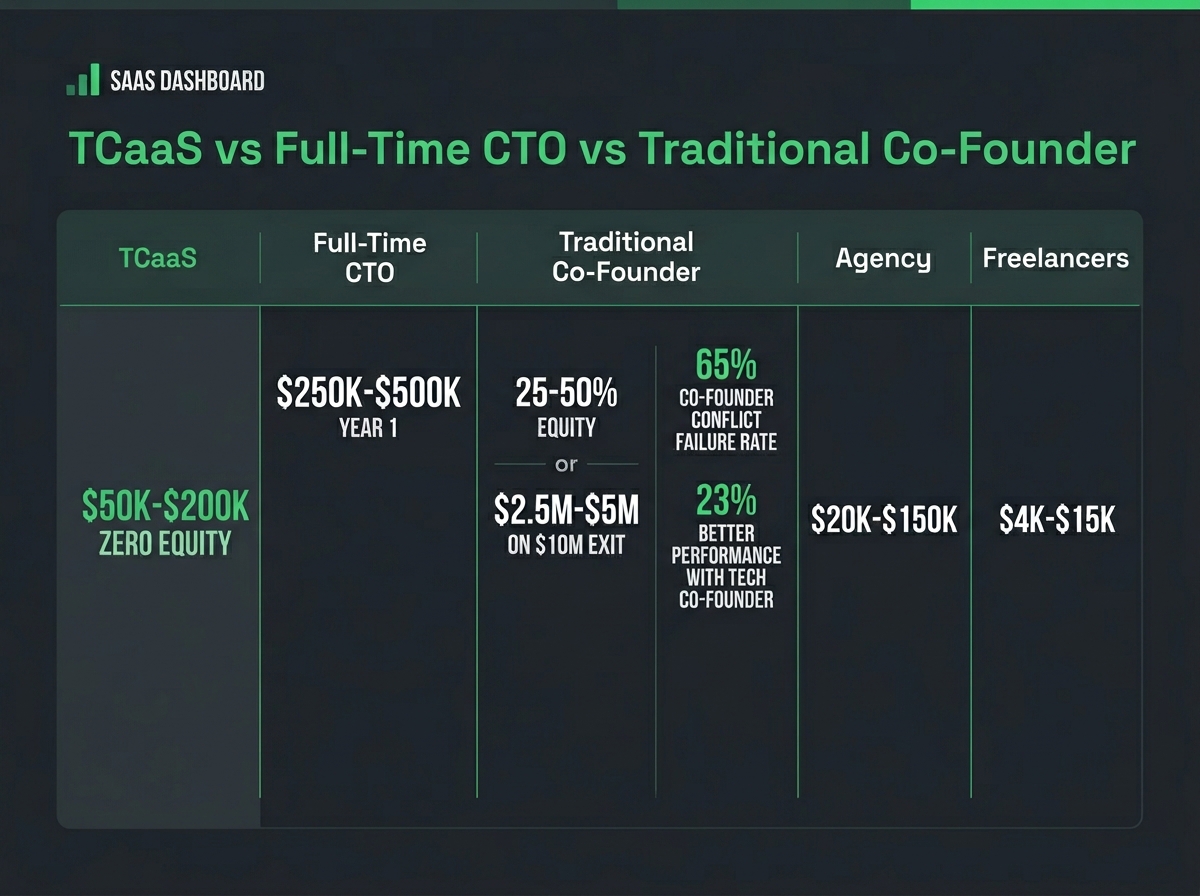
A full-time CTO is the gold standard, if you can afford it and if you can find one. The median CTO salary in the US ranges from $200,000 to $400,000 per year (per Wellfound and PayScale, 2026) before benefits, equity, and recruiting costs. Factor in a typical 25% recruiting agency fee and three months of reduced productivity during onboarding, and the real first-year cost lands between $250,000 and $500,000.
The hiring process itself takes six months on average, according to industry recruiting surveys. For a pre-seed startup burning $30,000 to $50,000 per month, six months of searching means $180,000 to $300,000 in burn before your CTO writes a single line of code.
A technical co-founder as a service starts in one to two weeks and costs a fraction of a full-time hire. You do not get someone full-time, permanently, with their entire career tied to your company. But for pre-seed and seed-stage startups, which is most of the companies we work with, the math strongly favors the service model. You get co-founder-level thinking without co-founder-level cost.
vs Using a Development Agency
Agencies build products. Good agencies build good products. But an agency’s job ends when the project ends.
The typical agency engagement runs $20,000 to $150,000 for an MVP. That is comparable to a technical co-founder engagement in raw cost. The difference is scope. An agency delivers a codebase. A technical co-founder delivers a technical strategy: architecture decisions that scale, technology choices that match your market, hiring plans for when you are ready to build an internal team, and the ability to sit in an investor meeting and explain your technical roadmap with credibility.
We have seen startups hire agencies to build MVPs, then spend more money rebuilding six months later because the agency optimized for delivery speed, not for the architectural decisions that matter at scale. The agency did not care whether you chose a monolith or microservices. They were not going to be around when that decision created problems. For a deeper look at this trade-off, see our comparison of a technical co-founder vs. a development agency.
vs Finding a Traditional Co-Founder
This is the comparison that matters most, because Y Combinator, First Round Capital, and most of the startup ecosystem still say: find a technical co-founder.
They are not wrong. Teams with two or more founders outperform solo founders by 163%, and solo founders receive seed valuations 25% lower than multi-founder teams, per the same First Round Capital analysis of 300+ portfolio companies (2015 data, the most comprehensive study available). The data is clear: having a co-founder helps.
But the data does not tell you about the cost. Sam Altman, former YC president, has described co-founder conflict as the leading cause of early startup death. Noam Wasserman’s research at Harvard Business School, covering roughly 10,000 founders, found that co-founder conflict is the primary factor in 65% of high-growth startup failures. Carta’s 2024 data from 32,000+ companies shows that 45.9% of two-person founding teams split equity equally, meaning a traditional technical co-founder typically walks away with 25% to 50% of your company.
Run the numbers. On a $10 million exit, that is $2.5 million to $5 million in co-founder equity. A technical co-founder as a service engagement costs $50,000 to $200,000, with zero equity dilution and zero breakup risk.
The honest answer: if you find the right co-founder, that relationship creates something a service never can. A partner who wakes up at 3 AM because the server is down and their equity depends on fixing it. No service replicates that. What a service eliminates is the 65% chance that partnership turns into the reason your startup dies.
vs Hiring Freelance Developers
Freelancers are the cheapest option for writing code. MVP development through freelancers typically runs $4,000 to $15,000, a fraction of any other approach.
But freelancers do not make strategic decisions. They do not tell you which features to build first. They do not design your data model for the use cases you will need in 18 months. They do not prepare technical documentation for investor due diligence. They do not interview and evaluate your first engineering hire.
Freelancers write code. Technical co-founders decide what code to write, how to write it, and why.
If you know exactly what you need built and just need hands to build it, freelancers work. If you need someone to figure out what should be built, and then build it, you need something more.
Comparison Table
| Factor | Full-Time CTO | Traditional Co-Founder | Agency | Freelancers | TCaaS |
|---|---|---|---|---|---|
| Upfront cost | $50K-$100K+ | $0 | $20K-$150K | $4K-$15K | $50K-$200K |
| Ongoing cost | $200K-$400K/yr | $0 salary | Project-based | $50-$200/hr | Monthly retainer possible |
| Equity impact | 10-20% | 25-50% | 0% | 0% | 0% |
| Time to start | 6+ months | Months to years | 2-4 weeks | 1-2 weeks | 1-2 weeks |
| Strategic depth | Full | Full | None to minimal | None | Full |
| Builds product | Yes | Yes | Yes | Yes | Yes |
| Hires your team | Yes | Sometimes | No | No | Yes |
| Fundraising support | Yes | Yes | No | No | Yes |
| Breakup risk | Firing costs | High, #1 startup killer (Altman) | Contract ends | Contract ends | Contract ends |
| Best for stage | Series A+ | Any (if you find the right person) | One-off projects | Small features | Pre-seed to Series A |
Want to talk through whether this model fits your startup? Book a free discovery call. 30 minutes, no pitch, just an honest assessment of your technical needs and which path makes sense for your stage.
When Should a Startup Use a Technical Co-Founder as a Service?
Not every startup needs this model. Some need a full-time CTO. Some need an agency. Some need a freelancer and a clear spec. Here is how to know whether a technical co-founder as a service fits your situation.
The 5 Signs You Are Ready
1. You have a validated idea but no technical leadership. You have talked to customers. You have demand signals. You might even have revenue from a no-code MVP or manual service. What you do not have is someone who can turn that validated concept into a real, scalable product. You need a technical co-founder, but you do not want to give away 30% of your company to get one.
2. Investors ask one question: who is building this? At the pre-seed and seed stage, that question determines whether you get a second meeting. A slide deck with “we will hire developers” does not cut it. A technical co-founder as a service gives you a named, credible technical leader who can answer due diligence questions in the room.
3. You spent $40,000 to $80,000. The MVP works. It cannot scale. We hear this one often. A founder hired an agency, got a working product, and then discovered the technology choices make iteration expensive or the architecture collapses under real load. Rebuilding hurts. But a technical co-founder does not just rebuild. They make the architectural decisions that prevent the same problem from happening again.
4. Can you tell whether a backend engineer actually knows what they are doing? Most non-technical founders cannot. A technical co-founder as a service designs your hiring process, writes job descriptions with real technical requirements, conducts technical interviews, and evaluates candidates. This is one of the highest-value parts of the engagement, and the one nobody talks about.
5. Your burn rate cannot support a full-time CTO. At $200,000 to $400,000 per year for a full-time CTO, plus benefits and equity, most pre-seed startups cannot afford it. A technical co-founder engagement at $50,000 to $200,000 gives you the same strategic capability at a fraction of the cost and commitment.
Who This Model Works Best For
From our engagements, the profile is consistent. Three traits predict whether this model works for you:
Non-technical founders with a validated business concept. They have done the customer discovery. They know the problem is real. They need technical execution and strategy, not business validation. Not sure if this applies to you? Read our guide on how to know if you need a technical co-founder.
Pre-seed and seed-stage startups. The economics work at this stage. Once you have raised a Series A and can afford a full-time CTO, hire one. The service model bridges the gap between “I have an idea” and “I can afford a permanent technical leader.”
AI and software ventures where speed matters. In 2026, AI-native development means a two-person technical team with the right tools can ship what used to require ten engineers. The technical co-founder as a service model is more viable than ever because the capability-to-cost ratio has shifted. A small, expert team building with AI tools can outpace a larger team building the traditional way.
What a Technical Co-Founder as a Service Actually Does
The title is self-explanatory until you try to define the boundaries. So here are the boundaries.
Technical Strategy and Architecture
This is where the engagement starts. It is also the part that separates a technical co-founder from a developer.
In the first two weeks, the work looks like this: auditing your current technical state (if anything exists), mapping product requirements against technology options, making build-versus-buy decisions for every major component, designing the data model, choosing the tech stack, and documenting the architecture in a way that survives the engagement.
The decisions you make in these two weeks determine 80% of your technical trajectory. Monolith or microservices. PostgreSQL or a NoSQL database. Authentication from scratch or a managed service like BetterAuth. These are not decisions a freelancer should be making. Most agency project managers are not qualified to make them either.
Product Development and MVP Building
After the architecture is set, building starts. A technical co-founder does not hand off a spec to developers. They build. In our case, that means writing code, reviewing pull requests, shipping features, and iterating based on what users actually do with the product.
The difference from an agency: we make product decisions while building. Which feature ships first. Which corner to cut in the MVP and which to build right from day one. When “good enough to test with users” is the right call versus when something needs more work before anyone sees it. For startups focused on speed, our approach to AI MVP development explains how modern tooling accelerates this phase.
Team Building and Hiring
Most founders underestimate this part of the engagement. It delivers some of the highest long-term value.
A technical co-founder as a service helps you write job descriptions that attract the right candidates. Not generic “full-stack developer” posts, but descriptions that specify the actual technologies, the actual challenges, and the actual stage of the company. We design your technical interview process. We conduct interviews alongside you. We evaluate whether a candidate’s experience actually matches what your startup needs at this stage.
We have seen founders hire their first engineer based on a portfolio and a good conversation, only to discover three months later that the engineer cannot work independently, cannot make architectural decisions, or built everything in a framework the rest of the codebase does not use. A technical co-founder prevents that mistake before it costs you six months.
Fundraising Support
Investors at the pre-seed and seed stage are not just evaluating your market opportunity. They are evaluating whether your team can execute. When a non-technical founder walks into a pitch meeting alone, the first question is often: “Who is building this?”
A technical co-founder as a service does not just give you an answer to that question. We prepare the technical sections of your pitch deck. We write architecture documentation that demonstrates thoughtful technical decisions. We build demo environments that investors can touch. We sit in the meeting and answer technical due diligence questions (scalability, security, data architecture, build timelines) with specifics, not hand-waving.
Investors notice the difference. A founder who says “we plan to use AI” gets skepticism. A founder who points to a named technical leader and says “here is our architecture, here are the trade-offs we evaluated, and here is why we made these choices” gets confidence.
Technology Due Diligence
We build every project as if due diligence is next week, because often, it is. Clean code, documented architecture decisions, test coverage. Not because we are optimizing for an audit, but because this is how code should be written. When investors do run due diligence, the codebase speaks for itself.
Not sure if you need a technical co-founder or if AI tools can get you further on your own? Schedule a discovery call. We will walk through your product, your stage, and your goals, and give you an honest assessment. Sometimes the right answer is to keep building yourself.
How to Evaluate Technical Co-Founder Services
The market for this type of service is growing fast, which means the quality range is wide. Some providers genuinely operate at co-founder level. Others are agencies that relabeled their offering. Here is how to tell the difference between a startup advisor vs cofounder-level partner.
7 Questions to Ask Before Hiring
1. “What companies have you built as a technical co-founder?” The answer should include specific companies, specific products, specific outcomes. Vague references to “various startups” or “multiple clients” are a red flag. You want names, stages, and what happened.
2. “What is your process for the first two weeks?” A real technical co-founder has a defined discovery, architecture, and strategy process. If the answer is “we start coding immediately,” they are a development shop, not a co-founder.
3. “How do you handle disagreements about technical direction?” This tests co-founder mentality versus contractor mentality. A contractor says “you are the client, we will do what you want.” A co-founder says “I will push back when I think we are making a mistake, and here is how we will resolve disagreements.”
4. “Who specifically will be working on my project?” You are hiring a person, not a brand. Know who your technical co-founder is: their background, their technical specialties, their availability. If the answer is “we will assign the right team member,” you are hiring an agency.
5. “What happens when the engagement ends?” A good technical co-founder as a service plans for the transition from day one. Documentation, knowledge transfer, hiring your replacement, and a clean handoff. If they have no transition plan, they are optimizing for retention, not for your success.
6. “What is your approach to AI and modern tooling?” Any technical leader building without AI-assisted development tools in 2026 is leaving speed and quality on the table. Ask how they use AI in their workflow and what productivity gains they have measured.
7. “Can you share references from founders you have worked with?” Non-negotiable. Talk to founders who have used the service. Ask what went well, what did not, and whether they would hire the same team again. A provider who cannot connect you with references is one you should not hire.
Red Flags to Watch For
- No named individuals. You are hiring a partnership, not a logo.
- Equity requests. A technical co-founder as a service does not take equity. That is the entire point. If they want equity, you are looking at a traditional co-founder arrangement dressed up as a service.
- No discovery phase. Anyone who quotes a price before understanding your product, market, and technical requirements is guessing.
- Promises of specific timelines before scoping. “We can build your MVP in 4 weeks” (before knowing what the MVP is) is a sales tactic, not a technical assessment.
- Heavy marketing language, light on specifics. If the website talks about “transforming your vision” but does not mention specific technologies, specific processes, or specific people, keep looking.
Fractional CTO vs Technical Co-Founder: Understanding the Difference
The distinction between a fractional CTO and a technical co-founder as a service confuses many founders. The market does not help. Some providers use the terms interchangeably.
Here is the difference.
A fractional CTO provides strategic oversight. They review architecture, attend board meetings, advise on technology decisions, and may manage engineering teams. They typically work 10 to 20 hours per week and charge $10,000 to $25,000 per month, based on current market rates. The right choice when you already have a development team and need someone to lead them strategically.
A technical co-founder as a service does all of that plus builds the product, hires the team, supports fundraising, and makes day-to-day technical decisions. The involvement is deeper. The scope is broader. The engagement is more intensive. A fractional CTO tells you what to build. A technical co-founder as a service tells you what to build and then builds it with you.
For a deeper comparison, see our fractional CTO guide.
Cost Comparison: Co-Founder vs CTO vs Agency
Money matters. At the pre-seed and seed stage, every dollar has to earn its place. Here is how the costs actually break down.
| Cost Factor | Full-Time CTO | Traditional Co-Founder | Agency | Freelancers | TCaaS |
|---|---|---|---|---|---|
| Year 1 total cost | $250K-$500K+ | $0 cash | $20K-$150K | $4K-$15K per project | $50K-$200K |
| Equity cost on $10M exit | $1M-$2M | $2.5M-$5M | $0 | $0 | $0 |
| Recruiting cost | $50K-$100K | $0 (but months of searching) | $0 | $0 | $0 |
| Onboarding time | 3+ months | Ongoing alignment | 2-4 weeks | 1 week | 1-2 weeks |
| Risk if it fails | Severance + lost time | High, #1 startup killer (Altman) | Lost project budget | Lost task budget | Lost engagement budget |
| Strategic value | High | Highest (if aligned) | Low | None | High |
| Can you end it cleanly? | Complicated | Often destructive | Yes | Yes | Yes |
The numbers tell a clear story for most pre-seed and seed-stage startups. A traditional co-founder is the cheapest in cash but the most expensive in equity and risk. A full-time CTO is the most expensive in cash but the safest in execution. A technical co-founder as a service sits in the middle: meaningfully cheaper than a CTO, zero equity impact, and lower risk than a traditional co-founder by every measure.
Here is the caveat. If your startup reaches a $100 million valuation, the co-founder’s 30% equity paid for itself many times over. The question is whether you are willing to bet on that outcome against a 65% co-founder conflict rate. For most founders, the math favors the service model until the company is large enough to justify a full-time technical leader.

FAQ
What is a technical co-founder as a service?
Short version: you hire a technical leader who works like a co-founder (strategy, architecture, building, hiring, fundraising) but you pay a fee instead of giving up equity. We built this model because the traditional path has a 65% conflict rate and costs founders 25% to 50% of their company. A technical co-founder as a service gives you the capability without the equity hit or the relationship risk. It is not an agency (they deliver a product but not strategy), not a freelancer (they deliver code but not decisions), and not a fractional CTO (they advise but typically do not build).
How much equity does a technical co-founder get?
Zero, when hired as a service. That is the entire point. A traditional technical co-founder typically receives 25% to 50% of the company’s equity. Carta’s 2024 data from 32,000+ companies shows 45.9% of two-person founding teams split equity equally. We charge a fee (typically $50,000 to $200,000 per engagement) and take no equity. Your cap table stays clean. If a provider calling themselves “technical co-founder as a service” asks for equity, they are a co-founder, not a service, and you should evaluate them accordingly.
How is this different from a fractional CTO?
Scope and involvement. A fractional CTO provides strategic oversight: reviewing architecture, attending board meetings, advising on technology decisions. They typically work 10 to 20 hours per week and charge $10,000 to $25,000 per month. We do all of that plus build the product, hire the team, support fundraising, and make day-to-day technical decisions. The simplest way to think about it: a fractional CTO tells you what to build. We tell you what to build and then build it with you.
When should a startup use a technical co-founder as a service?
Three scenarios where we see the strongest fit. First, pre-seed and seed-stage startups that have validated the business concept but have no technical leadership. You need someone to turn the idea into a real product without giving away 30% to 50% of the company. Second, startups preparing to raise funding that need technical credibility for investor conversations: architecture documentation, due diligence readiness, and a named technical leader who can answer hard questions in the room. Third, startups that tried the agency or freelancer route and ended up with a product that works but cannot scale. You need someone making the strategic technical decisions that prevent the same problem from recurring.
Can a technical co-founder as a service help with fundraising?
Yes, and this is one of the most undervalued parts of what we do. We prepare the technical sections of your pitch deck, write architecture documentation that demonstrates thoughtful decision-making, build demo environments, and join investor meetings to answer technical due diligence questions. The impact is measurable: investors evaluate teams, not just ideas. Y Combinator’s Dalton Caldwell and Michael Seibel have written that, based on the thousands of companies YC has funded, companies lacking a technical co-founder underperform, and that recruiting technical co-founding capability is “the single biggest way to create value as someone trying to start the next big thing.” A TCaaS provider gives you that technical presence in investor conversations without the equity cost of a permanent co-founder.
What happens when I am ready to hire a full-time CTO?
We plan for this from day one. The transition typically includes: documenting all architecture decisions and their rationale, creating onboarding materials for the incoming CTO, writing a technical roadmap that the new leader can pick up and execute, helping define the CTO job description and interview process, participating in candidate evaluation, and providing a 30- to 60-day overlap period where the incoming CTO can shadow the engagement before taking full ownership. The goal is a clean handoff, not dependency. If your TCaaS provider makes it hard to leave, they are not operating in your interest. The best sign that a technical co-founder engagement worked is that the company outgrows the service and hires a full-time leader who inherits a strong technical foundation. To see how we handle this, explore our technical co-founder services.
Making the Decision: Is Technical Co-Founder as a Service Right for You?
The startup ecosystem has spent two decades repeating a single piece of advice: find a technical co-founder. That advice is grounded in real data. Technical leadership on the founding team makes a measurable difference.
But the advice took shape in an era when the only way to get technical leadership was to find a person willing to quit their job, work for equity, and bet their career on your idea. That was always a hard sell. The failure rate of those partnerships proves it.
The options are broader than ever. AI-native development tools like Lovable, Bolt, Cursor, and v0.dev mean founders can build functional MVPs themselves. Fractional and as-a-service models mean technical leadership does not require a permanent hire. We actively encourage founders to vibe code and build with these tools. The more you can do yourself, the more focused a technical co-founder engagement can be on the genuinely hard problems: production architecture, AI infrastructure, scaling, security, and fundraising-grade technical credibility. The question is no longer “do I need someone to build this for me?” For many founders, the answer is no. You can build more than you think. The question is “where do I need experienced technical leadership to avoid expensive mistakes?”
For many pre-seed and seed-stage startups, the best path is to build as much as you can with modern AI tools, then bring in a technical co-founder as a service for the parts that require deep expertise: architecture, infrastructure, scaling, security, and fundraising support. Keep your equity. Eliminate the co-founder conflict risk. Build your product, with help where it matters. And when you are ready, when the company is large enough and the economics justify it, hire a full-time CTO who inherits a strong foundation instead of starting from scratch.
Not sure what you need? More building on your own, a co-founder, or something in between? Book a free discovery call with Downshift. We will give you an honest assessment. Sometimes the answer is to keep building with AI tools and come back when you hit a real wall. No commitment, no pressure, just clarity.