
Finding a technical co-founder is hard. Finding one for an AI startup is harder. The skill set is different, the architecture decisions carry more risk, and the wrong hire can burn through your runway on infrastructure that never ships a real product. Most advice about finding a technical co-founder was written for SaaS companies building CRUD apps on Rails. AI startups face a different problem entirely.
The good news: in 2026, AI development tools mean founders can build more of their product than ever before. But AI infrastructure (model selection, data pipelines, cost optimization, production hardening) is where the genuinely hard problems live. This guide covers what makes AI technical leadership different, where to find it, how to evaluate it, and how much it should cost you, in equity or cash. Whether you are building your MVP yourself with Cursor and Lovable or evaluating co-founders, this is the decision framework you need.
Why AI Startups Need a Different Kind of Technical Co-Founder
A SaaS startup needs a co-founder who can build a web app, set up a database, and deploy to production. That is table stakes. An AI startup needs all of that plus a second layer of expertise that most engineers do not have.
The gap between “can build software” and “can build AI products” is wider than most non-technical founders realize. A strong backend engineer who has never worked with LLMs will make expensive mistakes. Choosing the wrong model, over-engineering a pipeline that should be a single API call, or building deterministic UX patterns around a fundamentally non-deterministic technology.
The AI Skills Gap
Here is the reality. According to the World Economic Forum’s 2025 Future of Jobs Report, AI and machine learning specialists are the fastest-growing role category globally. Demand massively outstrips supply. The engineers who understand both product development and AI systems are a small subset of an already competitive talent pool.
For founders without deep AI production experience, this creates a compounding problem. Even founders who are building with AI tools like Cursor or Lovable may not be able to evaluate whether an engineer truly understands production AI systems. A backend engineer might interview well and demonstrate clean code, but if they have never shipped an AI product, they do not know what they do not know. They will build the wrong thing confidently.
The co-founder you need for an AI startup is not just a good engineer. They need to understand how LLMs behave in production, how to design products around probabilistic outputs, and how to keep infrastructure costs from eating your seed round.
Architecture Decisions That Make or Break AI Products
In a traditional SaaS startup, a bad architecture decision means you refactor later. Painful, but survivable. In an AI startup, a bad architecture decision can mean you are spending $40,000 a month on API calls that should cost $4,000. Or you built a custom model when a fine-tuned GPT-4o would have been better. Or you locked yourself into a provider that raises prices 3x after your product depends on it.
The first 30 days of technical leadership in an AI startup determine more of the company’s trajectory than the next 12 months combined. Model selection, embedding strategy, vector database choice, prompt architecture, caching layers, fallback handling. These decisions compound. A technical co-founder who gets them right saves you six figures in the first year alone.
What an AI Technical Co-Founder Must Know
Not every technical co-founder needs to be a machine learning researcher. Most AI startups in 2026 are building on top of foundation models, not training their own. But the skill set is still specific and non-negotiable.
LLM Integration and Prompt Engineering
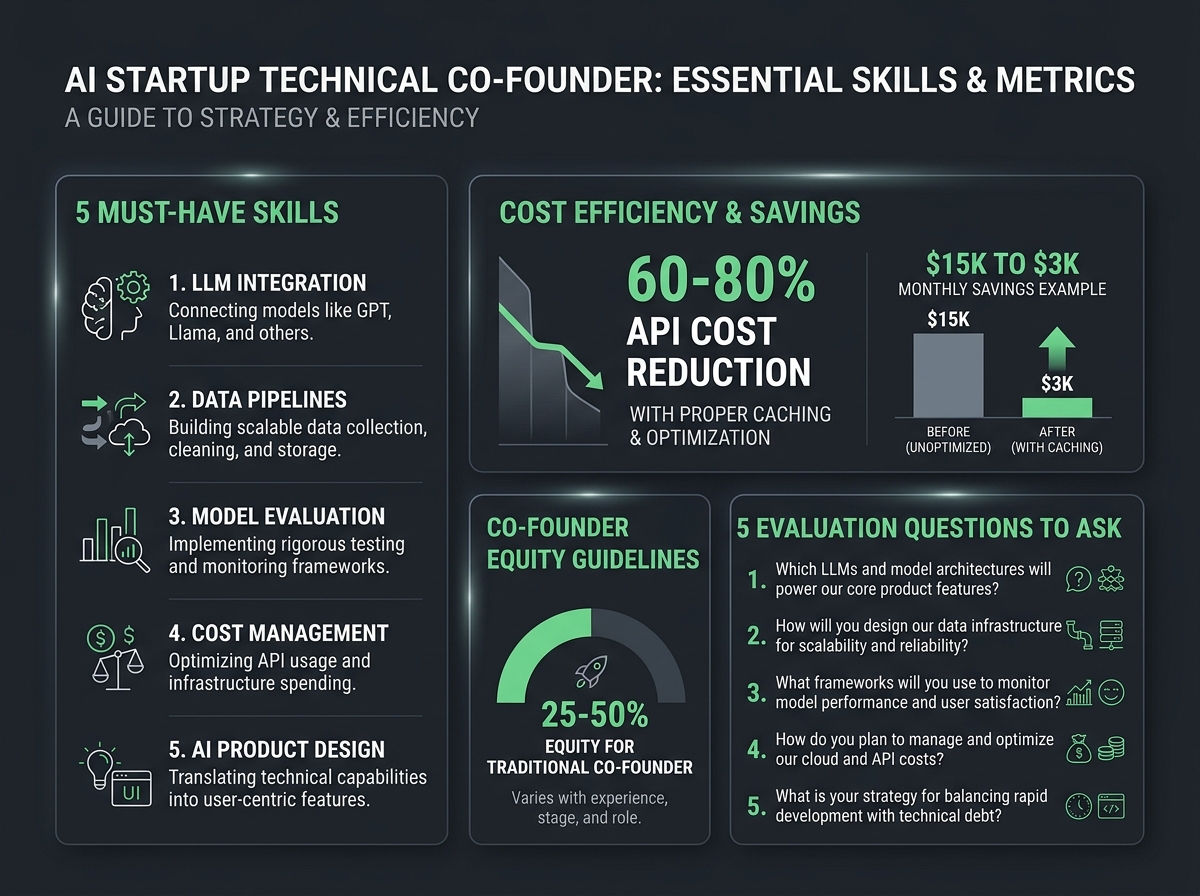
Your technical co-founder needs hands-on experience integrating LLMs into production systems. Not just calling an API. Designing prompt chains, managing context windows, handling token limits, building evaluation frameworks, and knowing when to use function calling versus structured outputs versus agent architectures.
Prompt engineering is not “writing good prompts.” It is systems design. The difference between a prototype that works in a demo and a product that works at scale is the engineering around the prompts: retry logic, output validation, cost tracking, latency optimization, and graceful degradation when the model returns garbage.
Data Pipeline Architecture
AI products live and die on their data. Your technical co-founder needs to know how to build ingestion pipelines, chunking strategies for RAG systems, embedding generation at scale, and vector database management. They need to understand the trade-offs between Pinecone, Weaviate, pgvector, and Qdrant, and pick the right one for your use case and budget.
They also need to build data pipelines that are auditable. When your AI product gives a wrong answer, you need to trace it back to the source data. This is not optional. It is a requirement for any serious B2B AI product and increasingly for B2C as well.
Model Selection and Evaluation
The model market shifts every quarter. Your technical co-founder needs to evaluate models on cost, latency, accuracy, and capability, not just pick whatever is newest. GPT-4o, Claude, Gemini, Llama, Mistral, and a dozen others each have different strengths. The right choice depends on your specific use case, your latency requirements, your budget, and your data privacy constraints.
A good technical co-founder builds evaluation harnesses. Automated benchmarks that test models against your specific tasks so you can make data-driven decisions instead of following hype cycles.
AI Infrastructure and Cost Management
AI infrastructure costs can kill a startup faster than a lack of product-market fit. A technical co-founder who does not understand cost management will burn through your runway on unnecessary compute.
The specifics: caching strategies that reduce redundant API calls by 60-80%. Tiered model routing that sends simple queries to cheaper models. Batch processing for non-real-time workloads. Token optimization that cuts input costs without degrading output quality. Monitoring dashboards that catch cost spikes before they become budget crises.
We have seen startups spending $15,000 a month on OpenAI API calls that could be reduced to $3,000 with proper caching and model routing. That is $144,000 a year. Real money at the pre-seed stage.
AI Product Design (Handling Uncertainty)
This is the skill most engineers miss entirely. Traditional software is deterministic. The same input always produces the same output. AI products are probabilistic. Sometimes the model is wrong. Sometimes it hallucinates. Sometimes it is confidently incorrect.
Your technical co-founder needs to know how to design products around this uncertainty. Confidence scoring. Human-in-the-loop workflows where they matter. Graceful error states that do not destroy user trust. Guardrails that prevent harmful outputs. Feedback loops that use real user interactions to improve the system over time.
The best AI products do not try to hide the AI’s limitations. They design around them in ways that feel natural to the user. That takes product sense and technical depth working together, exactly what a co-founder provides that a contractor does not.
Where to Find a Technical Co-Founder for AI
The search process is harder for AI startups because the pool of qualified candidates is smaller. Here are the three main routes, with honest assessments of each.
Traditional Routes (YC, AngelList, Founder Matching)
Y Combinator’s co-founder matching platform, AngelList, and services like CoFoundersLab are the standard starting points. They work. YC’s matching tool alone has produced companies worth billions in aggregate.
The limitation for AI startups: most engineers on these platforms are web and mobile developers. Finding someone with AI production experience requires filtering aggressively. Ask specifically about shipped AI products, not AI side projects or Kaggle competitions. A Kaggle medal does not mean someone can build a product that handles 10,000 users sending unpredictable inputs to an LLM.
Expect the search to take 3 to 12 months through traditional channels. That is time you do not have if your market window is closing.
Technical Co-Founder as a Service
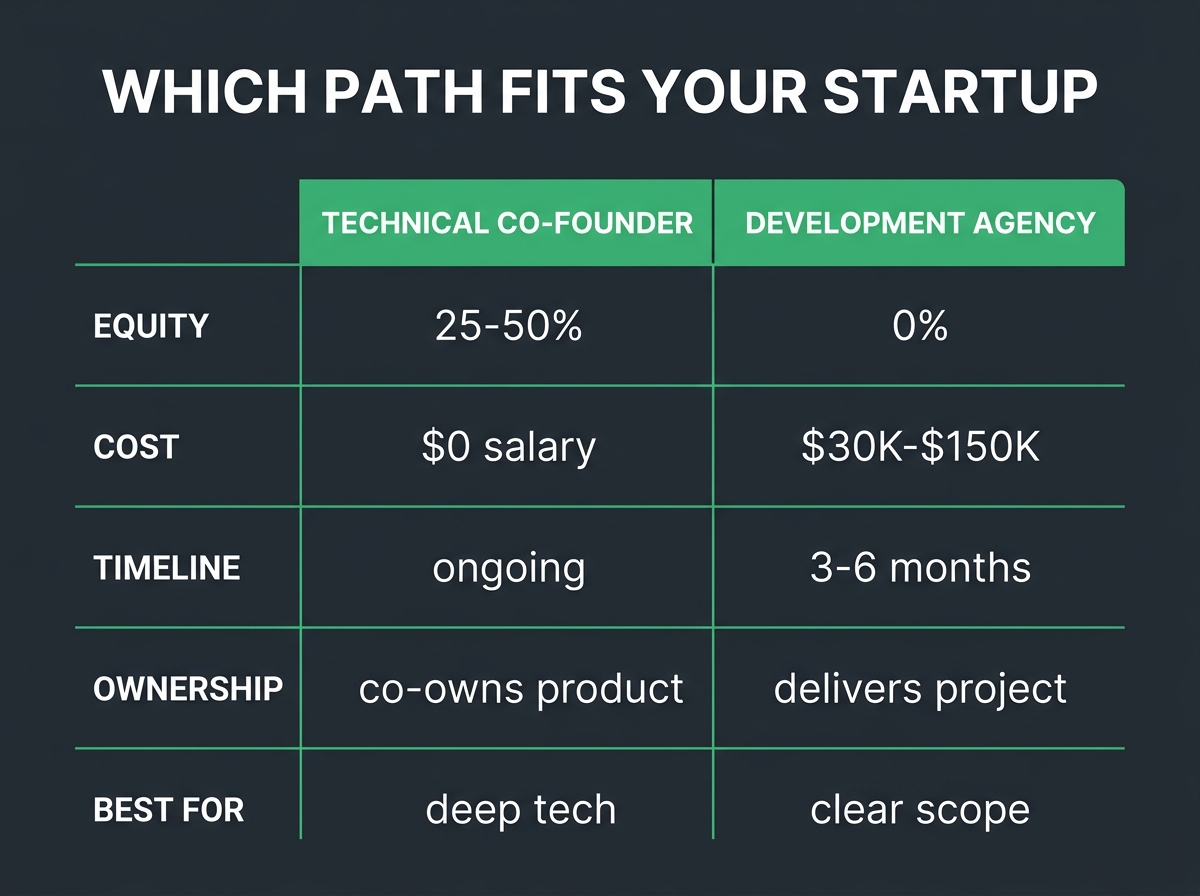
If the traditional search takes too long or you do not want to give up 25-50% equity before you have proven the concept, a technical co-founder as a service gives you co-founder-level AI expertise on a fixed engagement. You get architecture decisions, MVP development, fundraising support, and team hiring help, without the equity cost.
This model works especially well for AI startups because the early-stage technical decisions (model selection, data architecture, prompt engineering patterns) require deep expertise but do not require a permanent co-founder. Once the architecture is set and the MVP is validated, you can hire a full-time CTO who inherits a solid foundation. Our AI MVP development approach is built around exactly this. Scoped to what you actually need, delivered in weeks, zero equity.
Not sure if you need a co-founder, a service engagement, or if you can keep building on your own? Book a discovery call with Downshift. We will assess your AI product’s technical needs and give you an honest recommendation. Sometimes the answer is to keep vibe coding and come back when you hit infrastructure walls.
AI-Focused Communities
If you want to meet potential AI co-founders organically, go where they are. Hugging Face’s community forums and Discord. Local AI/ML meetups (check Luma and Meetup). AI-focused Slack communities like MLOps Community and Latent Space. Open-source AI project contributors on GitHub.
The advantage of these channels: you meet people by seeing their work first. Someone who contributes meaningfully to an open-source LLM framework has demonstrated real capability, not just interview skills.
The disadvantage: these communities are full of researchers and enthusiasts, not necessarily people who want to leave their job and co-found a startup. Converting interest into commitment takes time and persistence.
How to Evaluate AI Technical Expertise
Most non-technical founders cannot tell the difference between a strong AI engineer and a strong engineer who watched a few LLM tutorials. These filters help.
5 Questions to Ask
1. “Walk me through an AI product you shipped to real users. What broke?” You want specifics about production failures: hallucination handling, latency issues, cost overruns, edge cases. Anyone can build a demo. Shipping to real users is where the learning happens.
2. “How would you decide between using GPT-4o, Claude, and an open-source model for our use case?” The right answer involves trade-offs: cost per token, latency requirements, context window needs, data privacy constraints, and fine-tuning potential. A bad answer picks a model and justifies it with “it is the best.”
3. “Our AI feature costs $X per month in API calls. How would you reduce that by 70%?” This tests practical cost engineering: caching, model routing, prompt optimization, batch processing. If they cannot articulate specific strategies with rough percentage impacts, they have not managed AI costs in production.
4. “How do you handle it when the model gives a wrong answer to a user?” This tests product thinking. Good answers involve confidence thresholds, human review triggers, user-facing uncertainty indicators, and feedback mechanisms. Bad answers involve “make the prompt better.”
5. “Show me how you would evaluate whether a fine-tuned model outperforms a prompted foundation model for our specific task.” This tests evaluation methodology. You want to hear about test datasets, automated benchmarks, cost-per-quality-unit analysis, and A/B testing frameworks. Not vibes.
Portfolio Review Checklist
When evaluating a potential technical co-founder’s past work, look for these specific signals:
- Shipped AI products with real users. Not just prototypes, hackathon projects, or Jupyter notebooks.
- Evidence of cost management. Ask what their monthly AI infrastructure bill was and how they optimized it.
- Production monitoring. Did they have dashboards tracking model performance, latency, and cost in real time?
- Data pipeline experience. Can they explain their RAG architecture, chunking strategy, or embedding approach in detail?
- Iteration history. How many times did they change models, prompts, or architecture based on real user feedback?
- Security and compliance awareness. Especially important if your AI product handles sensitive data.
The Cost and Equity Trade-Off
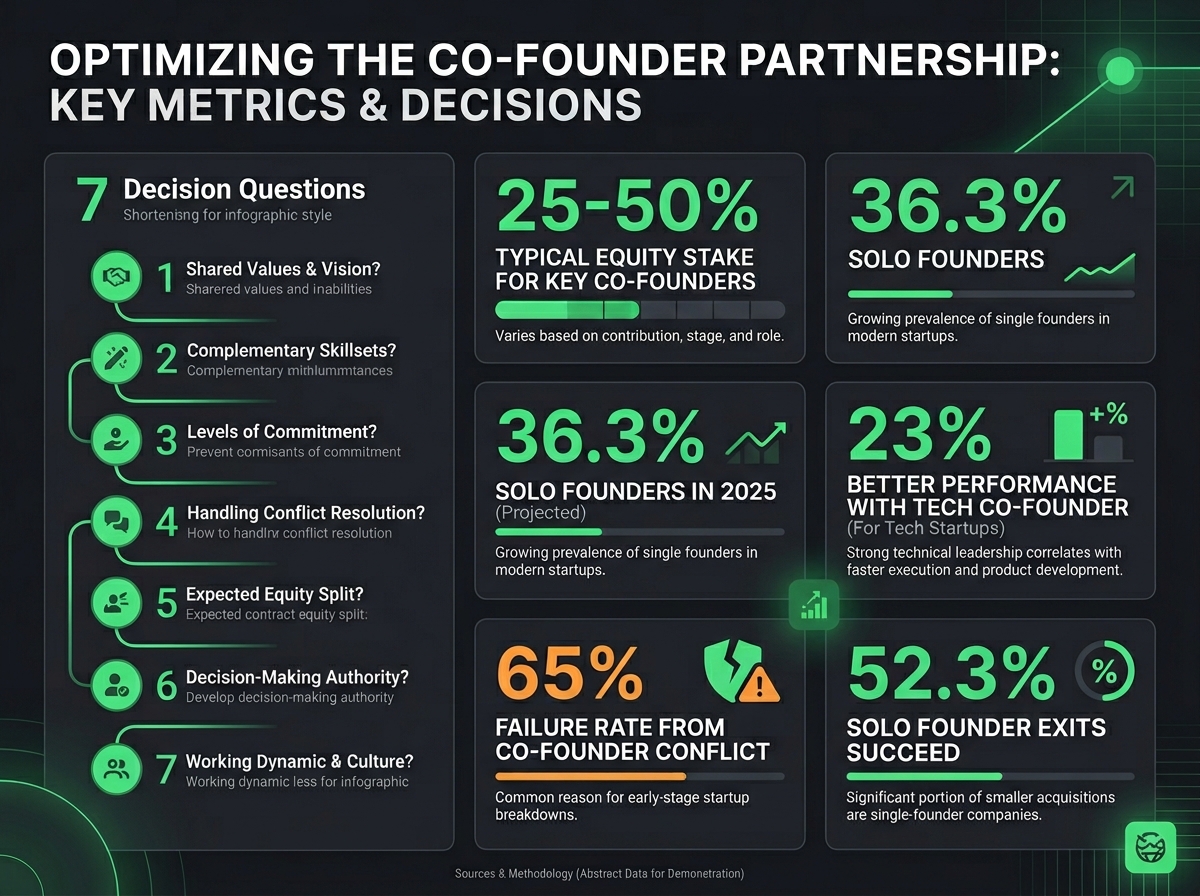
The standard advice says a technical co-founder gets 25-50% equity. Carta’s data from 32,000+ companies confirms that nearly half of two-person founding teams split equity equally.
For AI startups, run this calculation. If your company exits at $10 million, a 30% co-founder share costs $3 million. A technical co-founder service engagement costs a fraction of that with zero equity dilution.
The counter-argument is real: a co-founder with equity is maximally aligned. They will work nights, take pay cuts, and fight through the hard parts because their financial outcome depends on it. No service replicates that.
The question is whether you need that level of alignment at the stage you are at right now. If you are pre-product, pre-revenue, and pre-funding, and your primary need is making the right architecture decisions and shipping an MVP, the service model gives you the expertise without the equity cost. You can always bring on a full-time technical leader later, when you have revenue or funding to attract the right person.
FAQ
What technical skills does an AI startup co-founder need?
At minimum: LLM integration experience, data pipeline architecture, model evaluation methodology, AI infrastructure cost management, and the product sense to design around probabilistic outputs. They do not need a PhD in machine learning. Most AI startups in 2026 build on foundation models, not train their own. But they need production experience shipping AI products to real users, not just building prototypes.
Should an AI co-founder have ML expertise or full-stack skills?
Full-stack skills with strong AI integration experience. Unless your core product IS a novel ML model, you need someone who can build the entire product: frontend, backend, infrastructure, and AI layer. A pure ML researcher who cannot deploy a web application is the wrong hire for most AI startups. The ideal profile is a senior full-stack engineer who has spent the last 2-3 years shipping AI-powered products in production.
How much equity should I give a technical co-founder for an AI startup?
If you bring on a traditional co-founder, industry standard is 25-50%, with 50/50 being the most common split for two-person teams according to Carta’s 2024 data. But equity is not the only path. A technical co-founder as a service model, like Downshift’s, gives you co-founder-level AI expertise for a fixed engagement with zero equity dilution. The right choice depends on your stage, your runway, and whether you need a permanent technical partner or a strategic engagement to get your product built and funded.
Building an AI product and not sure where you need help? Book a free discovery call with Downshift. We will review what you have built, assess the technical complexity ahead, and give you a straight answer on whether you need a co-founder, a service engagement, or if you can keep building on your own. 30 minutes, no pitch.