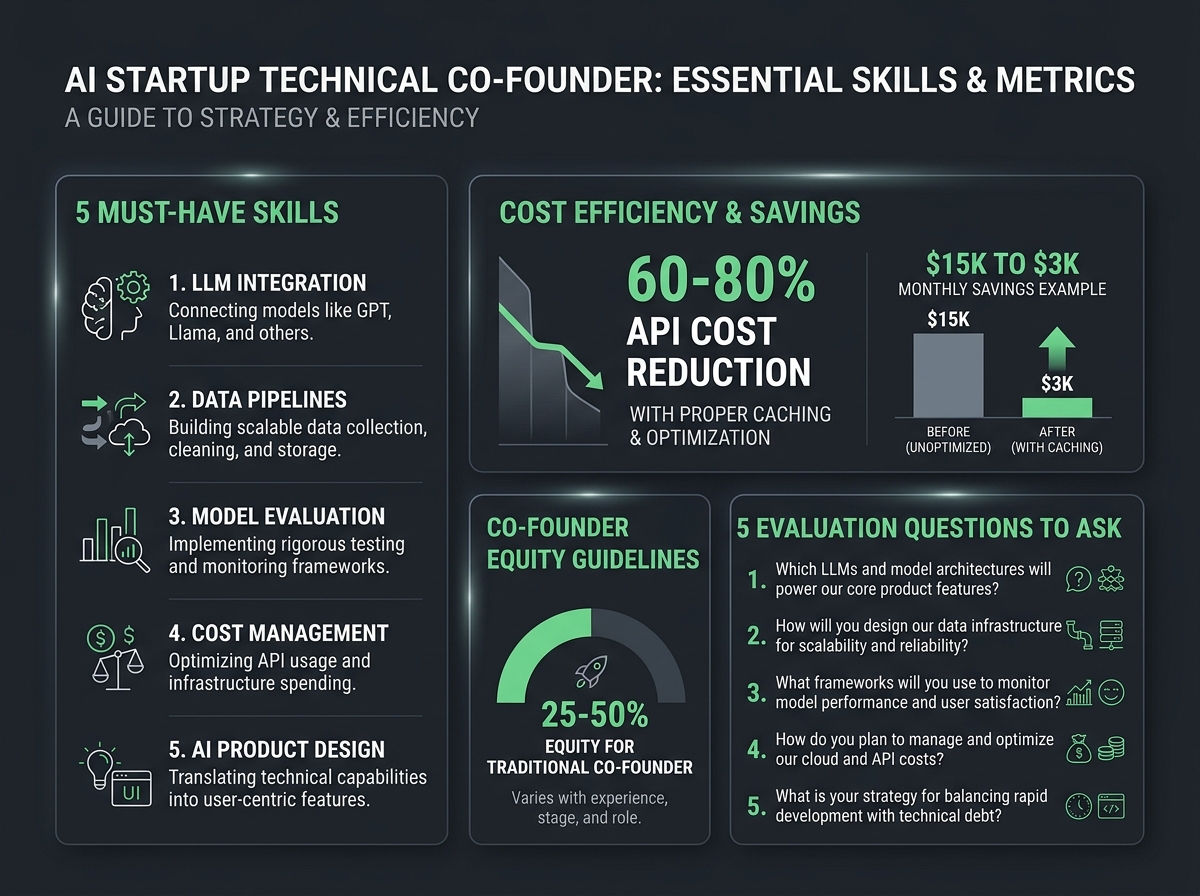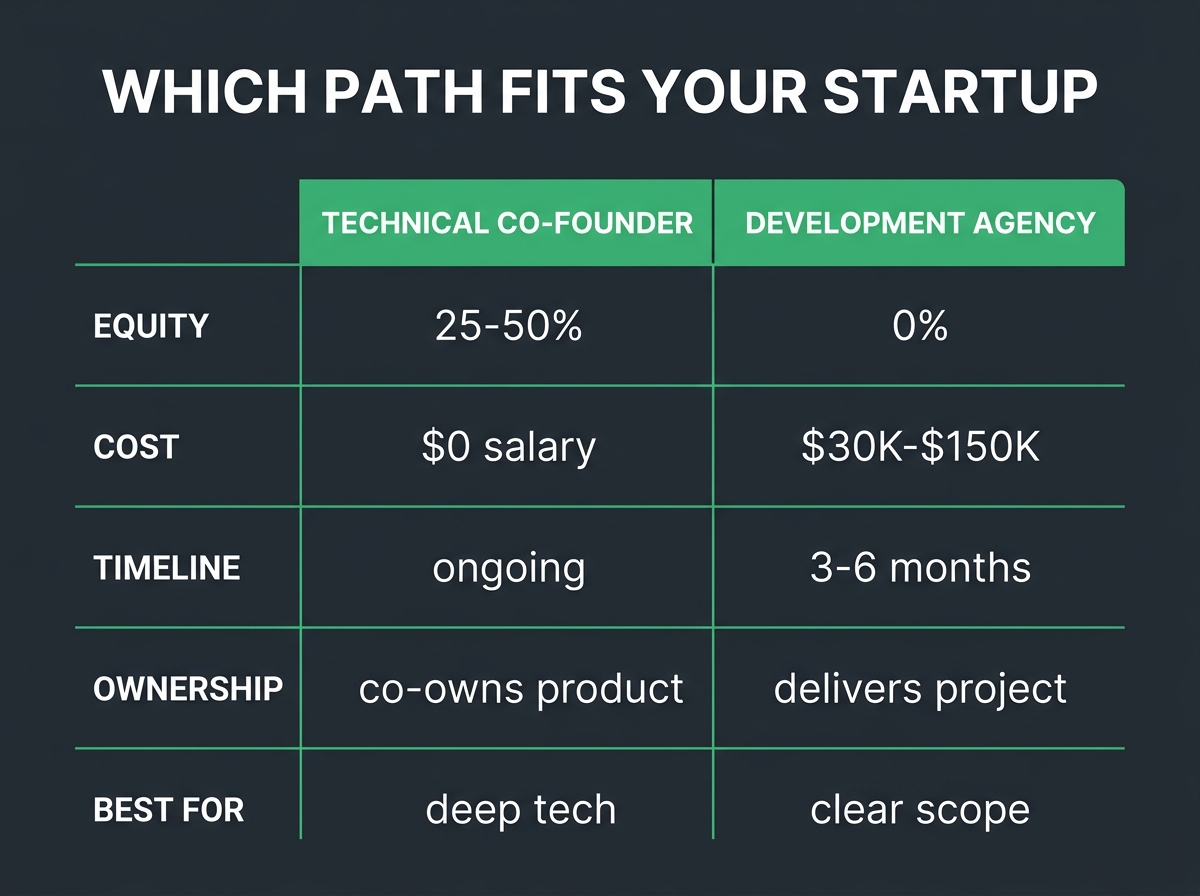

A technical co-founder will cost you 25-50% of your company. A development agency will cost you $20,000-$70,000. Both can build your MVP. But in 2026, there is a question this framing misses entirely: how much can you build yourself?
That is the real comparison most “technical co-founder vs development agency” articles skip. They list pros and cons in neat columns, tell you “it depends,” and leave you exactly where you started. This guide does something different. We run a technical co-founder as a service practice. We are the third option in this debate, so we will be transparent about when each model wins, when it loses, and when neither is what you actually need.
By the end, you will have a concrete decision framework: five questions that point you toward the right choice for your specific situation.
The Core Difference Between a Technical Co-Founder and an Agency
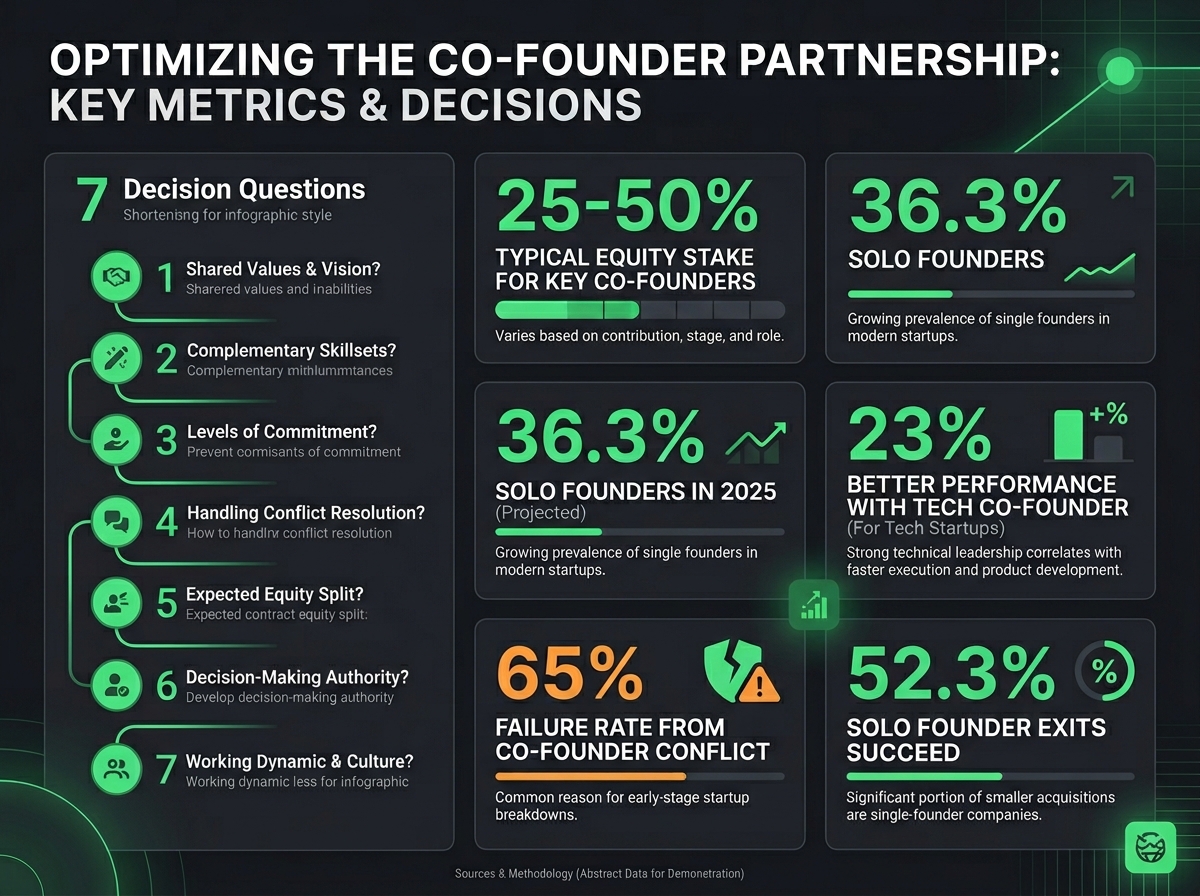
A technical co-founder is a long-term partner who shares ownership, risk, and upside. Their financial outcome is tied to your company’s success. You get strategic thinking, technical leadership, and someone who cares as deeply about the outcome as you do. The cost is permanent dilution and the relationship risk that kills 65% of high-potential startups.
A development agency is a vendor you hire to build a product. They charge cash, deliver code, and move on. You get speed, a full team, and no equity dilution. The cost is a lack of long-term alignment. Nobody at the agency loses sleep if your startup pivots into a wall six months after handoff.
Choose a technical co-founder when you need someone who will live in the problem with you for years. Choose a development agency when you have a clear spec and need execution. And consider whether you can build the product layer yourself, then bring in help for the architecture, infrastructure, and scaling challenges that genuinely require deep experience.
What a Technical Co-Founder Provides
A true technical co-founder is not just a developer who happens to hold equity. They sit in investor meetings fielding technical due diligence questions. They decide whether to build a feature in-house or buy a third-party API. They design your database schema for the use cases you will need in 18 months, not just the ones on your roadmap today.
Pros
Strategic alignment through equity. When your technical co-founder owns 25-40% of the company, every architecture decision is a personal financial decision. That level of skin in the game produces different thinking than a developer billing hourly. Carta’s 2024 analysis of 32,000+ companies shows the median two-co-founder equity split has narrowed to 51-49. Technical co-founders expect near-equal ownership.
Full-spectrum technical leadership. Architecture, hiring, investor relations, product strategy, vendor negotiations, security audits. A co-founder handles all of it because it is all their problem. An agency handles what is in the statement of work.
Long-term commitment. A co-founder is not going anywhere (ideally). Vesting schedules typically run four years with a one-year cliff, creating structural commitment. They will be there when the 3 AM production incident hits, when the pivot requires rebuilding the data layer, when the Series A investor asks about your scalability plan.
Cons
Equity dilution is permanent and expensive. On a $10 million exit, a 30% co-founder stake costs $3 million. On a $50 million exit, $15 million. That money does not come back if the relationship sours. Carta data shows 45.9% of two-person founding teams now split equity equally. Your co-founder may expect 50%.
Finding one takes months. Executive-level technical hiring averages 5-6 months. Finding a co-founder (someone who matches your vision, your work style, your risk tolerance, and has the right technical skills) takes longer. Your competitors are shipping while you search.
Co-founder conflict is the top startup killer. Noam Wasserman’s research at Harvard Business School, studying roughly 10,000 founders, found that co-founder conflict is the primary factor in 65% of high-potential startup failures. You are not just finding a developer. You are choosing a business marriage.
Skill gaps may not align. You need an AI/ML engineer who also understands product strategy, can manage a team, and communicates well with non-technical stakeholders. That combination is rare. Most technical co-founders are strong in two of those areas, not all four.
Best For
Startups where the technology IS the product: deep-tech, proprietary algorithms, research-heavy products where the technical vision is inseparable from the company’s value. Also critical for enterprise startups: First Round Capital’s analysis found technical co-founders improve enterprise startup performance by 230%.
What a Development Agency Provides
An agency is a team for hire. They have project managers, designers, frontend developers, backend developers, QA engineers, and they have built products like yours before. Dozens, sometimes hundreds of times. That pattern recognition is the product.
Pros
Speed. Agencies deliver MVPs in 8-16 weeks. They have established processes, component libraries, and deployment pipelines. While you spend 6 months searching for a co-founder, an agency has already shipped your v1.
No equity dilution. You pay cash, you keep your cap table clean. For a pre-seed founder who has not raised yet, this matters. Investors prefer clean cap tables, and every point of equity you give away before fundraising reduces your negotiating position.
A full team on day one. You do not hire one person and hope they can do everything. You get specialists: a designer who has built 50 mobile apps, a backend engineer who has scaled databases to millions of users, a PM who keeps everything on track.
Lower risk for validation. If your MVP proves the market does not exist, you have lost $20,000-$70,000. That stings. But you have not lost two years and 40% of your company.
Cons
Zero long-term alignment. When the project ends, the agency moves to the next client. Nobody at the agency is monitoring your error logs at midnight. You receive a codebase and a Slack channel that goes quiet.
Knowledge walks out the door. The developer who understood your AI prompt engineering, the one who knew why that database index exists. They are on someone else’s project now. Six months later, you are reverse-engineering decisions nobody documented.
Agency incentives diverge from yours. Agencies bill for time or deliverables. Their incentive is scope completion, not your startup’s long-term success. An agency will not tell you to cut a feature that takes 40 hours to build but generates zero user value, unless they are an unusually principled shop.
Rebuilds happen. We have seen this pattern repeatedly: a startup hires an agency for an MVP, raises a seed round, hires engineers, and those engineers recommend rebuilding half the codebase. The agency optimized for delivery speed. Nobody was thinking about the architectural decisions that matter at 10,000 users.
Best For
Startups that need to validate a concept fast, have a clear product spec, and plan to build an internal team after product-market fit. Also strong when the technology is standard (CRUD apps, marketplaces, content platforms) and the differentiation is in the business model, not the tech.
Head-to-Head: Technical Co-Founder vs Development Agency
| Factor | Technical Co-Founder | Development Agency |
|---|---|---|
| Cost | 25-50% equity ($2.5M-$5M on $10M exit) | $20,000-$70,000 cash |
| Timeline to start | 3-9 months (search + onboarding) | 1-4 weeks |
| Time to MVP | 3-6 months (solo, learning your domain) | 8-16 weeks (full team) |
| Equity impact | 25-50% dilution | Zero |
| Strategic depth | Full (architecture, hiring, fundraising) | Limited (builds to spec) |
| Long-term commitment | Years (ideally) | Project duration |
| Risk if it fails | Equity given, relationship damage | Cash spent, no ongoing obligation |
| Scalability | One person, must hire team later | Team scales with budget |
| Technical decision quality | High (fully invested in outcome) | Variable (depends on agency quality) |
| Knowledge retention | All knowledge stays in-house | Walks out the door at project end |
| Best for AI startups | Critical for deep-tech/ML research | Works for LLM API integration |
Decision Framework: 5 Questions That Give You the Answer
Stop reading comparison articles. Answer these five questions and the right choice becomes clear.
1. Is the technology your competitive moat?
If your startup’s value is a proprietary algorithm, a novel data pipeline, or a research breakthrough, you need a co-founder. Agencies build products. Co-founders build technical moats.
If your technology is an application layer on top of existing APIs (including LLM APIs), an agency or technical co-founder as a service can handle it. You do not need someone holding equity for execution-focused work.
2. Do you have a clear product spec?
Clear spec = agency. You know the features, the user flows, the integrations. You need hands to build it.
Unclear direction = co-founder. You need someone to sit with you, explore the problem space, make technology bets, and iterate on the product vision. Agencies need specs. Co-founders help create them.
3. What is your timeline pressure?
Market window closing in 3 months? Go agency. They start in weeks and ship fast.
Building for a multi-year vision and can invest 6-9 months finding the right person? The co-founder search makes sense. Rushing that search is worse than not searching at all.
4. What is your funding situation?
Pre-revenue with no funding? You may not have $20,000-$70,000 for an agency. A co-founder who works for equity is sometimes the only option.
Funded or bootstrapped with revenue? Cash gives you options: agencies, services, contractors. Do not give away equity when you can afford not to.
5. How technical are your ongoing needs?
If the MVP is 80% of the technical work and everything after is marketing and sales, go agency. Build it, ship it, maintain it with a part-time developer.
If the MVP is 20% of the technical work and the next three years are continuous technical innovation, go co-founder. You need someone who will be there for the long build.
The Third Option: Technical Co-Founder as a Service
There is a third option the “technical co-founder vs development agency” framing misses: technical co-founder as a service.
This model gives you co-founder-level strategic thinking (architecture decisions, technology selection, production hardening, fundraising preparation, hiring plans) without equity dilution. It works alongside what you are already building, not instead of it. You retain 100% ownership.
It works when:
- You need strategic technical leadership, not just code
- You cannot afford 6 months searching for a co-founder
- You are pre-seed and want to avoid equity dilution before raising
- Your product involves AI and you need someone who understands LLM integration, data pipelines, and model evaluation, not just web development
- You want co-founder-level thinking without co-founder-level equity cost
It does not work when:
- You need a permanent, full-time technical partner for 3+ years
- Your technology requires deep R&D that only a dedicated researcher can provide
- You want someone whose financial outcome is 100% tied to the company’s success
We run a technical co-founder as a service practice, so we will be direct: this model is not for everyone. If your startup needs a true co-founder, no service replaces that relationship. And if you can build your MVP yourself with modern AI tools, do it. We encourage that. Where we fit is the middle ground: founders who are building but need experienced technical leadership for architecture, infrastructure, scaling, security, or fundraising credibility.
Read our complete guide to technical co-founder services for a deeper breakdown of how this model works.
When an Agency Is the Right Call
Agencies win in specific situations. Be honest about whether these match yours:
You have a validated product spec. You have done customer discovery. You know the features. You have wireframes. You need execution, not exploration.
You need speed above all else. A funding deadline, a competitive launch window, a pilot customer waiting. Agencies deploy full teams and ship fast.
The technology is standard. Web apps, mobile apps, marketplaces, dashboards. The agency has built 20 of these. You do not need a co-founder to figure out how to build a CRUD app.
You plan to build internal engineering. The agency builds v1. You use traction to raise funding. You hire your own engineers. The agency was a bridge, not a destination.
FAQ
Is a technical co-founder better than an agency for AI startups?
It depends on the type of AI work. For startups building proprietary ML models, training custom algorithms, or doing AI research, a technical co-founder with deep ML expertise is difficult to replace. For startups integrating LLM APIs (ChatGPT, Claude, Gemini) into product experiences, the implementation is complex but not research-grade. An agency or technical co-founder as a service with AI experience can handle that well.
How much does a technical co-founder cost vs an agency?
A technical co-founder typically costs 25-50% equity. On a $10M exit, that is $2.5M-$5M. On a $50M exit, $12.5M-$25M. A development agency MVP runs $20,000-$70,000 in cash, with annual maintenance of 15-25% of the initial build cost. A technical co-founder as a service is scoped to what you actually need, which depends on how much you have built yourself and where you need expert help. Zero equity dilution.
Can I switch from an agency to a co-founder model?
Yes, but expect friction. The co-founder inherits a codebase they did not architect, decisions they did not make, and technical debt they did not create. Budget 2-4 weeks for the co-founder to audit the codebase and create a technical roadmap before productive building begins. Some rebuilding is almost always necessary.
Do I need a technical co-founder if I am using no-code tools?
For validation, no. No-code tools like Bubble, FlutterFlow, and Retool can build functional MVPs that test market demand. But no-code has ceilings: performance limits, customization constraints, scaling challenges. If your product outgrows no-code, you will need technical leadership. The question is when, not if.
The Decision That Shapes Your Startup
The technical co-founder vs development agency choice is not about cost or timeline. It is about what kind of company you are building.
If your technology is your moat, if the next three years require continuous technical innovation, if you need a partner whose financial future depends on the same outcome as yours, find a co-founder. Accept the equity cost, the search time, and the relationship risk. When it works, nothing matches it.
If you need a product built well and fast, if your differentiation is the business model rather than the technology, if you want to validate before committing, hire an agency.
And if you need co-founder-level thinking without co-founder-level equity cost, that third option exists.