
You have an AI startup idea. You are excited about it. Your friends say it sounds great. You are tempted to start building. Stop.
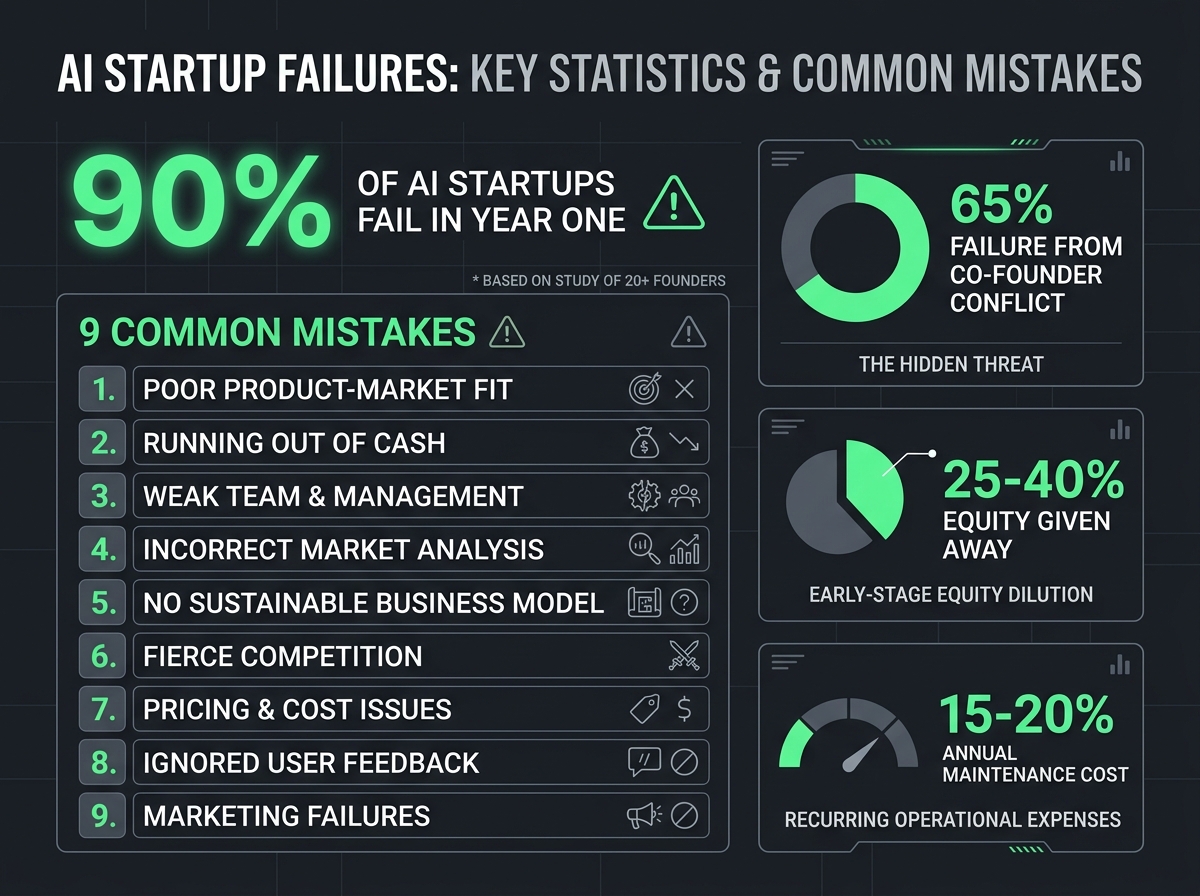
After working with AI startup founders across multiple verticals, the pattern is clear. The ones that survive share a single trait: the founders validated before they built. The ones that burned through $50,000 or more and ended up with nothing share a different trait: they skipped validation because they were “sure” the idea was good.
AI startup ideas fail for reasons that traditional startups do not face. The model might not be accurate enough. The data might not exist. The problem might be real but unsolvable with current AI. Validating an AI startup idea requires a different process than validating a SaaS tool or a marketplace, and that process costs $0 if you do it right.
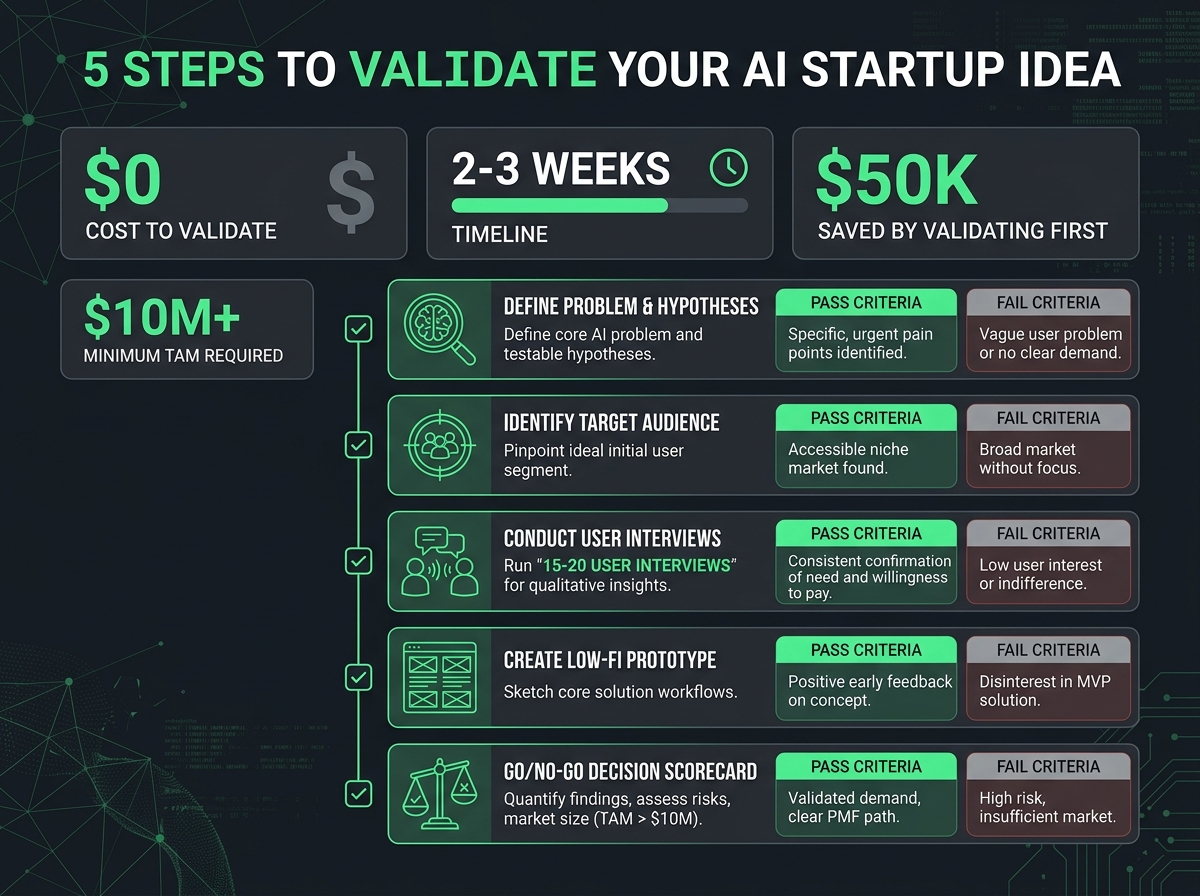
Here is the framework. Five steps. No code required.
Why AI Startup Validation Is Different
Traditional startup validation follows a well-known script. Talk to users. Confirm the problem exists. Check willingness to pay. Build an MVP. The Lean Startup methodology works, for traditional products.
AI startups add two variables that break the standard playbook.
The AI Feasibility Question
Most software ideas are technically feasible. If you want to build a project management tool, a booking system, or a CRM, the question is not “can this be built?” but “should this be built?” The technology exists. The question is market demand.
AI ideas introduce genuine technical uncertainty. Can a language model accurately classify legal documents with the precision lawyers require? Can a vision model detect manufacturing defects at the speed a production line demands? Can an AI agent reliably complete multi-step workflows without hallucinating intermediate results?
These are not hypothetical concerns. Rob Fitzpatrick’s The Mom Test teaches founders to separate real customer pain from polite enthusiasm. The same discipline applies to AI feasibility: separate what AI can actually do from what your pitch deck claims it can do. The gap between “AI can sort of do this in a demo” and “AI can do this reliably in production” has killed more AI startups than bad market timing.
Data Availability as a Gating Factor
Traditional SaaS products launch with an empty database. Users create the data as they use the product. AI products often need data before the product can function at all.
A recommendation engine needs behavioral data. A document classifier needs labeled training examples. A RAG-based knowledge product needs a curated corpus. If that data does not exist, cannot be obtained, or is locked behind compliance requirements you cannot meet, your AI startup idea is dead on arrival, no matter how strong the market demand.
Data availability is not a “nice to check” item. It is a gating factor. Validate it before everything else, or waste months discovering your AI has nothing to learn from.
The AI Startup Validation Framework (5 Steps)
Complete this framework before you write a line of code. Before you hire anyone. Before you spend a dollar. This is the process that separates validated ideas from expensive guesses.
Step 1: Problem Validation (Is This Worth Solving?)
The question is not “is this a cool AI application?” The question is: do real people have this problem, and do they care enough to pay for a solution?
How to validate:
- Talk to 15-20 potential users. Not friends. Not other founders. People who match your target customer profile. Ask about their current workflow, their frustrations, and what they have tried. Follow The Mom Test. Do not pitch your idea. Ask about their life.
- Quantify the pain. “It is annoying” is not enough. You need: How much time does this problem cost them per week? How much money? What happens when the problem is not solved? A problem that costs someone 10 hours per week is worth solving. A problem that mildly irritates them once a month is not.
- Check for existing solutions. If people are duct-taping together spreadsheets, hiring assistants, or using three different tools to solve this problem, you have validation. If they shrug and say “it is fine, we deal with it,” the pain is not acute enough.
Pass criteria: At least 10 out of 15 users confirm the problem exists, can quantify the cost, and express clear interest in a better solution. Not “that sounds cool,” but interest backed by specifics about how they would use it and what they would stop doing.
Step 2: AI Feasibility Check (Can AI Actually Solve This?)
You have confirmed the problem is real. Now: can AI solve it well enough that users will trust it?
How to validate:
- Define “good enough.” What accuracy does your use case require? A content suggestion tool can be useful at 70% relevance. A medical diagnosis tool needs 99%+. A legal document classifier that is wrong 15% of the time is worse than useless. It creates liability. Write down the minimum acceptable performance threshold for your use case.
- Test with existing models. Take 20-30 real examples of the problem and run them through GPT-4, Claude, or whatever foundation model fits your use case. No code. Just the API playground or chat interface. How close does the output get to your “good enough” threshold? This 2-hour test tells you more about feasibility than a month of architecture planning.
- Identify the hard edges. Where does the model fail? Edge cases, ambiguous inputs, domain-specific jargon, multi-step reasoning. These failure modes become your technical roadmap. If the hard edges are narrow and predictable, the problem is solvable. If the model fails on core use cases, not edge cases, the AI is not ready.
Pass criteria: Foundation models achieve 60-70%+ of your “good enough” threshold with basic prompting on real examples. The remaining gap is closable through prompt engineering, fine-tuning, RAG, or domain-specific guardrails, not a research breakthrough.
Step 3: Data Audit (Do You Have or Can You Get the Data?)
AI without data is a promise without evidence. This step determines whether you can actually feed your AI what it needs to perform.
How to validate:
- Map your data requirements. What data does your AI need to function? Training data, evaluation data, retrieval data, user-generated data. Be specific: “500 labeled examples of contract clauses” is a requirement. “Lots of legal data” is not.
- Check availability. Does this data exist? Can you access it legally? Is it in a format AI can process? Common blockers: data exists but is behind enterprise firewalls, data exists but is governed by HIPAA/GDPR/SOC-2, data exists but is in scanned PDFs that need OCR preprocessing, data does not exist and you would need to create it from scratch.
- Estimate acquisition cost. Free public datasets, licensed commercial datasets, synthetic data generation, manual labeling. Each path has a cost in time and money. A startup that needs 10,000 labeled medical images and has no medical imaging partnerships is facing a $50,000+ data acquisition project before the product can even be tested.
Pass criteria: You can acquire sufficient data to build and evaluate a working prototype within 4 weeks and under $5,000. If data acquisition alone requires six figures and six months, you have a research project, not a startup.
Step 4: Market Sizing (Is the Market Big Enough?)
A validated problem with a feasible AI solution still fails if the addressable market is too small to build a business on.
How to validate:
- Bottom-up sizing. Count the number of potential customers, estimate what they would pay per month or per year, and multiply. “There are 12,000 insurance adjusters in the US. If we capture 5% at $200/month, that is $1.44 million ARR.” Bottom-up sizing is grounded and honest. Top-down sizing (“the insurance market is $1.3 trillion”) is fantasy math that convinces nobody.
- Check willingness to pay. Go back to the users you interviewed in Step 1. Describe the solution. Name a price. Watch their reaction. “Would you pay $200/month for a tool that cuts your claims review time from 45 minutes to 5?” A hesitation followed by “I would need to check with my manager” is a yes. An immediate “absolutely” with no context is often a polite no (The Mom Test again).
- Compare to alternatives. What do users pay for their current solution? If they spend $0 today, your price needs to justify a new budget line. If they spend $500/month on manual labor that your AI replaces, $200/month is an easy sell.
Pass criteria: Bottom-up TAM of at least $10 million with a realistic path to $1 million ARR within 2 years. If the math requires capturing 80% of a niche market to hit $1 million, the market is too small.
Step 5: Competitive Moat Assessment (Can AI Be Your Advantage?)
The final question: even if you build this, can someone else copy it in a weekend?
How to validate:
- Check for thin-wrapper risk. If your product is a user interface on top of an OpenAI API call with a custom prompt, you do not have a product. You have a feature that OpenAI, Google, or any developer can replicate in days. The common AI startup mistakes we see most often start here. Founders building thin wrappers and calling them startups.
- Identify your defensibility. Defensible AI products have at least one of: proprietary data that competitors cannot access, a domain-specific workflow that takes months to understand and encode, a feedback loop where user interactions make the product better over time, or distribution advantages (existing customer relationships, channel partnerships, brand trust).
- Assess the competitive timing. Are incumbents already building this? Is OpenAI about to release a feature that makes your product redundant? Check product roadmaps, YC batches, and recent funding announcements. If three well-funded competitors launched in the last 6 months, your window may be closing.
Pass criteria: You can articulate at least two sources of defensibility beyond “we were first” or “our prompts are better.” If your only advantage disappears when a competitor spends a week on prompt engineering, you do not have a moat.
The $0 Validation Toolkit
You do not need to spend money to validate. Every step above can be completed with free tools.
Free Tools for Each Step
| Step | Tool | What It Does |
|---|---|---|
| Problem Validation | Google Forms, Calendly, Zoom | Survey distribution, user interview scheduling, interview recording |
| AI Feasibility | ChatGPT free tier, Claude free tier, Google AI Studio | Test your use case against foundation models with real examples |
| Data Audit | Kaggle, Hugging Face Datasets, Google Dataset Search | Find existing public datasets for your domain |
| Market Sizing | Census.gov, IBISWorld (library access), LinkedIn Sales Navigator (free trial) | Industry statistics, company counts, target customer profiling |
| Competitive Moat | Product Hunt, Crunchbase (free tier), Y Combinator company directory | Track competitors, funding, and new launches in your space |
Total cost: $0. Total time: 2-3 weeks of focused work. Total value: the difference between spending $50K on a validated idea and spending $50K on a guess.
Red Flags That Kill AI Startup Ideas
Stop validation and reconsider if you encounter any of these:
“The AI just needs to be a little bit better.” If current foundation models cannot get close to your accuracy threshold with basic prompting, the gap is not a little bit. Closing a 30% accuracy gap requires custom model training, proprietary data, and deep ML expertise. That is a research timeline, not a startup timeline.
“We will figure out the data later.” Data is not a detail you work out after launch. If you cannot identify a clear, legal, affordable path to the data your AI needs, the idea stalls at Step 3.
“Everyone we talked to said they love it.” If 100% of your interviewees are enthusiastic, you are either asking leading questions or talking to the wrong people. Real validation includes skeptics, people who have tried similar solutions and been burned, and people who push back on your price.
“Our advantage is that we are using AI.” AI is a technology, not a business model. In 2026, every startup is “using AI.” Your advantage must be something specific (specific data, specific domain expertise, specific distribution) that happens to use AI as the delivery mechanism.
“The market is huge, $X trillion.” Top-down TAM numbers are meaningless. If you cannot size the market from the bottom up (counting customers, estimating deal sizes, mapping conversion rates), you do not understand the market well enough to build for it.
When to Move from Validation to Building
You have passed all five steps. The problem is real. The AI works well enough. The data is accessible. The market is big enough. You have a defensible angle. Now what?
The move from validation to building is not gradual. It is a decision. You stop researching and start committing resources: time, money, and attention.
Build when:
- All five validation steps pass their criteria
- You can describe your product in one sentence without using the word “AI” (the value is the outcome, not the technology)
- You have 3-5 users who said “tell me when it is ready,” and you believe them
- You can afford the build without betting everything on this single idea
- Your AI feasibility test showed a clear path from “demo quality” to “production quality”
Wait when:
- Two or more validation steps produced ambiguous results
- Your feasibility test required “assume the model gets better next year”
- The data acquisition path is unclear or prohibitively expensive
- Every user interview required you to explain why AI makes this better
The founders who build the strongest AI companies are the ones who are hardest on their own ideas during validation. They look for reasons to stop, not reasons to continue. The ideas that survive that scrutiny are the ones worth building.
Ready to move from validation to building? Start with the tools available to you (Cursor, Lovable, Bolt, v0.dev) and see how far you can get. When you hit the hard parts (architecture, AI infrastructure, production hardening), book a discovery call with Downshift. 30 minutes, zero commitment. We will walk through your validation results, assess technical feasibility, and figure out together where you need help and where you can keep building on your own.
FAQ
How do I know if my AI startup idea is viable?
A viable AI startup idea passes five tests: the problem is real and quantifiable (users can describe the cost in time or money), AI can solve it at production-grade accuracy (not just demo quality), the data exists and is accessible, the market is large enough to support a business ($10M+ TAM), and you have at least two sources of defensibility beyond the AI itself. If any of these fail, the idea needs rework before it is worth building.
What data do I need to validate an AI startup?
You need three types of data during validation. First, customer evidence: interview transcripts, survey results, and willingness-to-pay signals from 15-20 potential users. Second, feasibility evidence: test results from running 20-30 real examples through foundation models to prove the AI can handle the core use case. Third, market evidence: bottom-up TAM calculations based on real customer counts and realistic pricing, not top-down industry reports.
How long should AI startup validation take?
Two to three weeks of focused, full-time work. Problem validation (user interviews) takes one week. AI feasibility testing and data audit take three to five days. Market sizing and competitive analysis take three to five days. Founders who stretch validation beyond a month are usually avoiding a hard conclusion the data has already given them.
Should I build a prototype during validation?
Not during validation. A prototype answers “can AI do this?”, which is Step 2 of the framework. But a prototype is not code. It is 20-30 real examples tested against a foundation model in a chat interface or API playground. Save code for after all five validation steps pass. Building a prototype too early biases you toward your solution instead of the problem.